EdTech Software Development: Types, Process, Compliance, and Cost

EdTech software development is the process of designing, building, and shipping educational technology products, from learning management systems and student information systems to adaptive learning and virtual classroom tools, in accordance with the privacy and accessibility requirements that govern software used by learners.
EdTech software differs from general business software in two ways: it must comply with strict privacy rules when serving minors, and it must meet accessibility standards for adoption by schools and universities. This guide covers the main types of EdTech software, the build process, the compliance baseline, the cost and timeline, and how to decide whether to build custom, adapt an existing platform, or integrate third-party tools.
Atta Systems builds custom EdTech software for schools, universities, and education companies, including the education products EdXP and StudySmart, scoping the privacy and accessibility baseline into the first version rather than retrofitting it after launch.
The main types of EdTech software
EdTech software development covers five main categories, each serving a different part of the teaching and learning workflow: learning management systems, student information systems, adaptive learning platforms, virtual classroom tools, and assessment software. The category determines the core workflow, the primary buyer, and which compliance requirements apply.
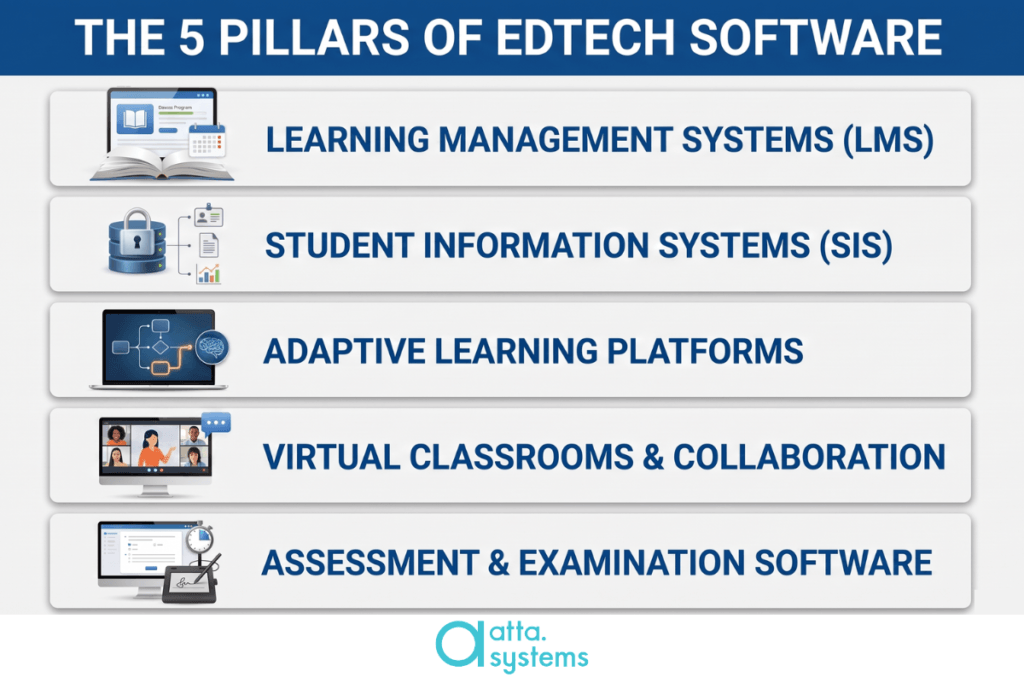
- Learning management systems (LMS). An LMS organizes courses, content, assignments, and grades in one place. It is the backbone of most EdTech deployments, and the system other tools integrate with.
- Student information systems (SIS). An SIS manages enrollment, records, attendance, and reporting. It holds the most sensitive student data, which makes its privacy and security requirements the strictest of any EdTech category.
- Adaptive learning platforms. These adjust content and pacing to each learner based on performance data. They depend on learning analytics and, increasingly, on AI models that personalize the learning path.
- Virtual classroom and collaboration tools. These support live and asynchronous teaching through video, shared workspaces, and messaging. They center on real-time reliability and on accessibility for all learners.
- Assessment and examination software. These deliver quizzes, tests, and formal exams, sometimes with proctoring. They include integrity requirements (to prevent cheating) alongside the privacy and accessibility requirements common to all EdTech.
Most EdTech products combine several of these categories. A learning platform often bundles an LMS with assessment and analytics. The buyer type also shapes the build: K-12 schools, higher education institutions, and corporate or consumer learning each have different procurement rules, budgets, and compliance expectations.
Who buys EdTech software, and why it changes the build
EdTech software serves three distinct buyer types, and the buyer shapes the entire build: K-12 schools, higher education institutions, and corporate or consumer learners. Each has a different procurement process, budget cycle, and compliance profile.
- K-12 schools. K-12 buyers have the strictest privacy requirements because they serve minors, and they procure through districts on annual budget cycles. Software serving K-12 must address FERPA and, for younger students, COPPA, and will not be piloted without them.
- Higher education institutions. Universities buy through longer procurement cycles involving IT, faculty, and administration. They prioritize integration with existing systems (the campus LMS, the SIS, single sign-on) and accessibility compliance.
- Corporate and consumer learners. Corporate learning and direct-to-consumer education buy faster and prioritize engagement and outcomes over institutional integration. Their compliance load is lighter, though data protection still applies.
The EdTech compliance baseline
The EdTech compliance baseline is the set of privacy, accessibility, and data protection requirements that education software must meet before schools and universities will adopt it. The requirements depend on the buyer and the learners served, but a common core applies across most EdTech products. For custom EdTech builds under these constraints, see Atta Systems custom EdTech software.
| Requirement | What it covers | When it applies |
| FERPA | Family Educational Rights and Privacy Act: protects the privacy of student education records and governs who can access them. | Any software handling student records for US schools and universities. |
| COPPA | Children’s Online Privacy Protection Act: requires verifiable parental consent before collecting data from children under 13. | Any software collecting data from children under 13, common in K-12. |
| WCAG accessibility | Web Content Accessibility Guidelines, commonly WCAG 2.1 AA: standards ensuring software is usable by people with disabilities. | Any software adopted by schools or universities that requires accessibility. |
| Data protection law | Regional data protection rules such as GDPR (General Data Protection Regulation) in the EU, governing consent, data residency, and user rights. | Any product serving learners in a regulated jurisdiction. |
| Interoperability standards | Education data standards such as LTI (Learning Tools Interoperability) and OneRoster, which let EdTech tools connect to an existing LMS and SIS. | Any product that must integrate with institutional systems. |
Accessibility and privacy are not features a team can add after a school pilot fails. Schools will not pilot a product that lacks them, so they belong in the first version. This is why an EdTech minimum viable product serving K-12 costs more and takes longer than a consumer app: the compliance baseline is part of the minimum, not an enhancement.
The EdTech software development process, step by step
Building EdTech software follows six steps, from defining the learners and buyer to launching and iterating on adoption. As with other regulated software, early compliance and integration decisions are inexpensive, whereas late decisions are costly.
- Define the learners, the buyer, and the compliance profile. Identify who uses the software (age group, institution type) and who buys it, then derive the compliance baseline (FERPA, COPPA, WCAG, data protection). This defines what the first version must include.
- Design the architecture and integration model. Decide how the product connects to existing institutional systems (the LMS, the SIS, single sign-on) through interoperability standards, and choose whether to build custom, adapt a platform, or integrate third-party tools.
- Build the core learning workflow. Implement the single most important workflow first, whether that is delivering a lesson, running an assessment, or managing enrollment, with accessibility built in from the start rather than added later.
- Integrate privacy, consent, and accessibility. Wire in student data protection, parental consent flows where COPPA applies, and WCAG-conformant interfaces. In EdTech, these are part of the core build.
- Test, including accessibility and privacy testing. Run functional testing, accessibility auditing against WCAG, and privacy validation against the requirements scoped in step one. Pilot with real teachers and learners where possible.
- Launch and iterate on adoption. Ship to the institution or the market, then iterate based on adoption and learning-outcome data. EdTech success is measured by whether teachers and learners actually use the product, not just whether it ships.
Atta Systems begins each EdTech engagement with a discovery sprint that scopes the compliance baseline and the integration model before development starts, so privacy and accessibility are designed in rather than retrofitted.
EdTech software development cost and timeline
EdTech software development costs $40,000 to $120,000 for a minimum viable product and $120,000 to $400,000 or more for a full platform, as of the second half of 2026. Timelines run from 3 to 6 months for a minimum viable product to 10 to 16 months for a full platform. Cost and timeline vary by the software type, the buyer’s compliance requirements, the number of institutional integrations, and the build model.
| Scope | Cost range | Timeline | What it includes |
| MVP (single core workflow) | $40,000 to $120,000 | 3 to 6 months | One learning workflow plus the mandatory compliance baseline |
| Full platform | $120,000 to $400,000 or more | 10 to 16 months | Multiple workflows, full compliance, and institutional integrations |
| Platform adaptation | $30,000 to $100,000 | 2 to 4 months | Configuration of an existing LMS or platform |
Build custom, adapt a platform, or integrate third-party tools
EdTech software development offers three build models: building custom software, adapting an existing platform such as an open-source LMS, or integrating third-party tools via interoperability standards. The choice determines cost, time to market, the degree of control the team retains, and how well the product fits a specific teaching model.
| Factor | Build custom | Adapt a platform | Integrate third-party |
| Time to market | 6 to 16 months | 2 to 4 months | 1 to 3 months |
| Fit to teaching model | Exact; built to the specific pedagogy | Good, within the platform’s limits | Constrained by the tools available |
| Control and ownership | Full ownership of code and roadmap | Partial; bound to the base platform | Limited; dependent on third parties |
| Cost | Highest upfront | Moderate | Lowest upfront, ongoing fees |
| Best for | Differentiated products with a specific pedagogy | Standard needs on a proven base | Fast assembly of common features |
FAQ about EdTech software development
EdTech software development costs $40,000 to $120,000 for a minimum viable product and $120,000 to $400,000 or more for a full platform, as of the second half of 2026. Cost varies by the software type, the buyer’s compliance requirements, the number of institutional integrations, and the build model.
An EdTech minimum viable product covering a single core workflow takes 3 to 6 months, and a full platform takes 10 to 16 months. Adapting an existing platform or integrating third-party tools shortens the timeline because the foundation is already built.
EdTech software serving US schools needs FERPA compliance for student records, COPPA compliance when it collects data from children under 13, and WCAG accessibility conformance to be adopted by institutions. Products serving regulated jurisdictions must also meet data protection laws such as GDPR. The exact requirements depend on the buyer and the learners served.
A learning management system (LMS) organizes courses, content, and grades for teaching and learning, while a student information system (SIS) manages enrollment, records, attendance, and reporting. Many institutions run both, integrated so that the LMS handles instruction and the SIS handles the official record. The SIS holds more sensitive data and carries stricter privacy requirements.
Build custom when the product needs a specific pedagogy or a differentiated experience that existing platforms cannot deliver, and adapt an existing platform when the needs are standard and speed matters more than exact fit. Adapting is faster and cheaper upfront, while custom gives full control and an exact fit to the teaching model at a higher cost.
Atta Systems builds custom EdTech software for schools, universities, and education companies, including EdXP, scoping the privacy, accessibility, and integration baseline during a discovery sprint so the compliance requirements are designed in from the first version.
Atta Systems focuses on custom EdTech development where privacy and accessibility are part of the minimum, across learning management, student information, adaptive learning, and assessment software, rather than off-the-shelf platform resale or general consumer app development without education-specific requirements.

Related Articles