How an Assessment Engine Works and How to Build One

An assessment engine is software that stores a test’s questions, selects which ones each test-taker sees, scores answers, and reports results. It is the part of an education or testing platform that decides what a candidate sees, in what order, how answers are graded, and whether the results are trustworthy. Four components do this work: the question bank, the test delivery layer, the scoring engine, and the reporting layer.
Atta Systems builds education software, including the EdXP learning platform for K-12 exam preparation, and this guide explains how such an engine works and what it takes to build one.
It covers the decisions that separate a reliable assessment engine from a quiz feature: how the question bank is structured, how adaptive tests choose questions, how security is built into delivery, and where accessibility and the EU AI Act come in. It is written for product and engineering teams.
What an assessment engine does, component by component
An assessment engine breaks into four components, and most of the hard engineering lives in the first two. Treating the engine as a single database application works at first, but gets expensive when a team adds adaptive tests or scoring that must stand up to scrutiny.
- Question bank: the store of questions, each with its content, the logic for marking an answer correct, metadata such as subject and topic, and, for adaptive tests, statistical values calibrated from real responses. The bank is the asset; everything else operates on it.
- Test delivery: the logic that decides which questions a candidate receives, in what order, and under what rules (time limits, navigation, randomization). It ranges from a fixed form everyone sees to an adaptive test computed in real time.
- Scoring engine: the logic that turns answers into a score, from simple right-or-wrong tallies to model-based ability estimates. Scoring must be auditable: for any high-stakes result, the platform has to show how it was reached.
- Reporting: the layer that presents results to candidates, educators, and administrators and exports data for analytics. For institutional use, reporting is where record-keeping obligations surface.
The question bank: structuring and calibrating questions
A question bank in an assessment engine is a structured repository of test questions, each with the content, metadata, and statistics needed to use it reliably. In testing, individual questions are called items, which is why some standards and methods below use that word. Without consistent metadata, and for calibrated adaptive tests, a platform cannot assemble a balanced test or defend a score.
Each question typically carries five kinds of data:
| Question attribute | What it holds and why it matters |
|---|---|
| Content and answer logic | The question text, options or input, and the rule that determines a correct answer, including partial credit |
| Classification metadata | Subject, topic, learning objective, and cognitive level, so a test can be assembled to a content blueprint |
| Statistical values | For adaptive tests or comparable scores across forms, IRT-calibrated difficulty and discrimination values (see the adaptive tests section) |
| Usage and exposure data | How often and how recently the question has been served, which drives security and retirement decisions |
| Lifecycle status | Draft, under review, live, or retired, so the bank can be governed and audited over time |
This structure leads to two engineering decisions. The first is interoperability. Question and Test Interoperability (QTI), currently version 3.0 (released May 2022 and maintained by the standards body 1EdTech), is the open format for exchanging questions and tests between authoring tools, question bank software, and delivery systems. Building to QTI keeps a question bank portable and avoids locking an institution’s question library into one vendor.
The second is calibration, which matters only for adaptive tests or for comparing scores across different test forms. Calibration means estimating each question’s statistical values from real response data by piloting questions with a representative group of test-takers and fitting an Item Response Theory (IRT) model, rather than labeling difficulty by hand. Required sample sizes vary by model: simpler models can work with a few hundred test-takers, while three-parameter models typically need more. A common rule of thumb is to write about three times the intended test length, since some questions do not survive calibration.
A question bank doesn’t need to be calibrated to be useful, and many learning platforms embed an assessment engine for practice and exam preparation. The EdXP learning platform, which Atta Systems built for K-12 students preparing for IBDP, SAT, and IGCSE exams, is an example of an assessment engine inside a learning platform. It holds more than 2,000 questions with explained solutions across 10 subjects and five assessment methodologies, runs an assessment mode that evaluates problem-solving within a limited time frame, and gives students real-time, personalized feedback.
Adaptive tests: how computer adaptive testing works
An adaptive test, delivered by an assessment engine through computer adaptive testing (CAT), chooses each next question based on the test-taker’s answers so far. A strong candidate moves quickly to harder questions, while a struggling one isn’t forced through questions that reveal nothing new. CAT rests on Item Response Theory (IRT), a psychometric model that relates a question’s difficulty and discrimination to a candidate’s estimated ability, written as theta. The engine runs a four-stage loop.
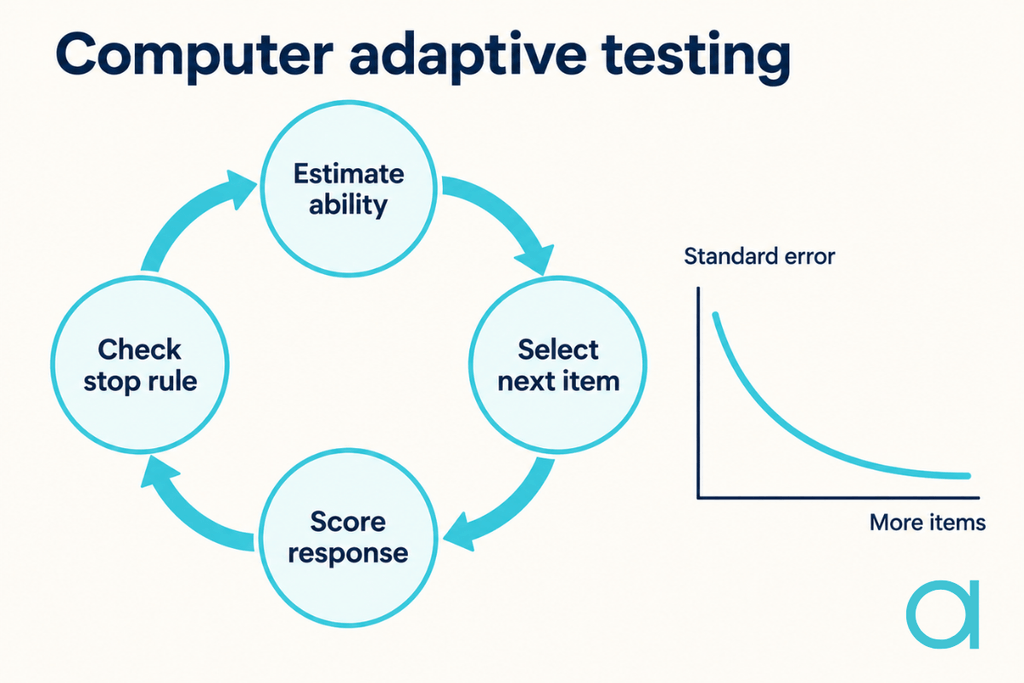
- Estimate ability. Start every candidate at an initial theta, either the same value for everyone or one informed by prior data, and update that estimate after each answer.
- Select the next question. From the pool of calibrated, unused questions, pick the one that gives the most information at the current theta, usually by maximum Fisher information, subject to content-balancing and exposure constraints.
- Score the answer. Re-estimate theta using the IRT model, typically via maximum likelihood or a Bayesian method, to tighten uncertainty around the estimate.
- Check the stopping rule. If the rule is met, end the test and report; if not, return to question selection and repeat.
The stopping rule is where much of the test design is decided, and there are three main kinds:
- Fixed length: stop after a set number of questions. Simple, but it adapts difficulty without adapting length, so it spends questions on candidates who were measured precisely early.
- Precision-based: stop when the uncertainty (standard error) of the ability estimate falls below a threshold, such as 0.30, so every candidate is measured to the same confidence regardless of how many questions that takes.
- Decision-based: for pass/fail exams, stop once the engine is confident the candidate is above or below the passing standard, because only which side of the line the candidate is on matters.
In practice, an engine combines a minimum and maximum length with a precision or decision rule. The NCLEX nursing licensure exam, a well-known adaptive test, runs from 85 to 150 questions and stops once the system is 95 percent confident the candidate is above or below the passing standard, a clear example of the decision-based rule. Adaptive tests often reduce test length by 50 to 90 percent while maintaining comparable precision.
Adaptive selection does not always mean IRT-based CAT. Learning platforms often use simpler rules that pick questions by difficulty level or recent performance. In a Clutch review of Atta Systems, EdXP’s co-founder describes students starting with a diagnostic assessment, after which the platform “comes up with an assessment based on the difficulty level.” StudySmart SG, another Atta Systems client, describes in its Clutch review a platform that “selects questions tailored to the student’s performance.” This kind of rule-based selection is cheaper to build and needs no calibration, but it sacrifices the measurement precision a calibrated adaptive test provides.
Adaptive tests are not always the right choice. Calibrating a question bank and building the selection logic is expensive, so the delivery model is a real build decision.
Test delivery models, least to most adaptive
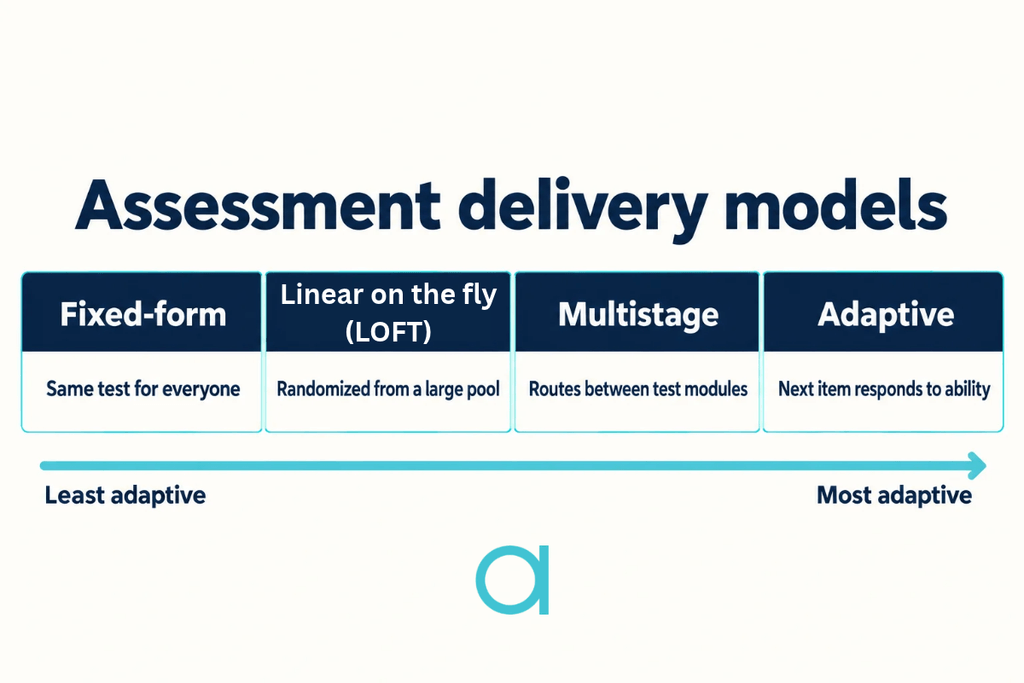
| Delivery model | How it works | When it fits |
|---|---|---|
| Fixed-form (linear) | Every candidate gets the same questions in the same order | Low stakes, small question banks, or when all candidates must see identical content |
| Linear-on-the-fly (LOFT) | Each candidate gets a unique linear form assembled from the bank to the same blueprint | Security matters but full adaptivity is not needed; requires a larger bank |
| Multistage (MST) | Candidates are routed between pre-assembled sets of questions based on performance at each stage | A middle ground: some adaptivity with more control over test content than question-by-question CAT |
| Computer adaptive (CAT) | Each question is selected in real time from a calibrated bank based on current ability | High stakes, a large calibrated bank, and a need for efficiency and uniform precision |
Security: how an assessment engine protects test results
Assessment security is the set of controls that prevent results from being gamed, and in a well-designed assessment engine, most of them are decided when you build the question bank and delivery layer. Exam security software and online exam proctoring tools build on this foundation; they don’t replace it. The controls fall into three layers.
- Exposure controls: randomizing question and answer order, drawing each candidate’s questions from a larger pool (LOFT or adaptive tests), capping how often any question is served, and retiring over-exposed questions. These depend on how the question bank and selection logic were built, which is why security has to be designed in from the start.
- Session controls: time limits, controlled navigation, browser locking or running the exam in a secure client, and detection of multiple sessions or tab switching. These live in the delivery layer.
- Supervision and detection: remote proctoring (live, recorded, or automated anomaly flagging), identity verification, and after-the-fact analysis, such as response-time and answer-similarity checks, that flag suspicious patterns for human review.
Adaptive tests help online exam security, within limits. Adaptive delivery combined with exposure controls reduces how often any question is seen. Without those controls, an engine that always picks the most informative question overuses a small set of questions, and candidates of similar ability tend to receive similar ones. Adaptive tests are open to item harvesting, where test-takers memorize and share questions, so exposure caps and regular question-bank refreshes matter as much as the selection method.
Proctoring and student data carry specific legal obligations. In the US, FERPA protects student education records, and COPPA applies to children under 13; in the EU, GDPR applies to student data. The compliance section of Atta Systems’ guide to custom EdTech software covers each.
Accessibility: accommodations and assistive technology
Accessibility in an assessment engine means every candidate can take the test on equal terms, and it is decided in the delivery and question bank layers, not added at the end. Three requirements come up in most projects:
- Accommodations: extra time and other adjustments set per candidate, which the delivery layer has to apply to timers and stopping rules without affecting anyone else’s test.
- Assistive technology support: the test interface, including timers, navigation, and answer controls, works with screen readers and keyboard-only navigation.
- Accessible question content: text alternatives for images and diagrams, and math and science notation that assistive technology can read. QTI 3.0 includes accessibility support, so questions authored to it can carry this information with them.
For assessments run by EU public bodies, the EU Web Accessibility Directive applies, with the standards set out in WCAG 2.2 accessibility requirements for public-sector software.
Where the EU AI Act applies to an assessment engine
The EU AI Act applies to an assessment engine only if a component counts as an AI system under the Act’s definition, which is a classification question. The definition covers machine-based systems that infer from their inputs how to generate outputs such as predictions or decisions. A question selector driven only by human-written rules is generally outside it, while a machine-learning model that grades answers or decides what a learner sees next may fall inside.
Where a component is an AI system, two of the education functions listed in Annex III point 3 make it high-risk: AI that evaluates learning outcomes, including when the result steers a learner’s path, as an adaptive engine can, and AI that monitors and detects prohibited behavior during tests, as automated proctoring does. High-risk obligations for these functions apply from December 2, 2027. Separately, Article 5 of the Act prohibits AI systems that infer emotions from biometric data in educational institutions, except for medical or safety reasons, and that ban has applied since February 2, 2025. It matters for proctoring tools that claim to detect stress or emotion. The guide to AI in EdTech under the EU AI Act covers which features are high-risk and what to build before the deadline.
How to build an assessment engine
Building an assessment engine is a serious undertaking, so the first decision is whether to build at all. An off-the-shelf assessment platform makes sense when needs are standard and the organization does not own specialist question content. Building, or extending an existing platform through QTI and its APIs, makes sense when the question bank is the core asset, when the product needs delivery or scoring behavior the market does not offer, or when the assessment sits inside a wider product. That last case is common in learning platforms, where the engine must share data, identity, and reporting with everything around it, shaping the EdTech software development process as a whole.
For teams that build, the work runs in five steps:
- Model the question bank first. Define the question attributes and lifecycle, and author to QTI 3.0 if the questions need to stay portable.
- Choose the delivery model. Choose fixed-form, LOFT, multistage, or adaptive tests based on the stakes, the size of the bank, and whether questions can be calibrated.
- Build scoring with an audit trail. Record how every high-stakes score was reached so you can explain and defend it.
- Design security and accessibility into delivery. Include exposure controls, session controls, accommodations, and screen-reader support in the first release, because they are hard to retrofit.
- Check legal obligations before launch. Confirm whether any component is an AI system under the EU AI Act, and map student data to FERPA, COPPA, or GDPR as they apply.
The most expensive decisions to reverse come first: how the question bank is modeled, whether questions are calibrated, and whether security is built into delivery.
FAQ about assessment engine architecture
A question bank is a structured repository of test questions, each with its content, classification metadata (subject, topic, objective), and, for adaptive tests or comparable scores, calibrated statistical values. It is the core asset of an assessment engine because a balanced, defensible test can be assembled only from questions that are described and measured consistently.
An adaptive test, delivered through computer adaptive testing (CAT), selects each next question based on the candidate’s performance so far. It estimates the candidate’s ability (theta) using Item Response Theory, selects the most informative unused question at that ability, re-estimates after each answer, and stops when it meets a precision or decision rule. The result is a shorter test with comparable precision.
QTI (Question and Test Interoperability) is the open standard, currently QTI 3.0 and maintained by 1EdTech, for exchanging questions and tests between authoring tools, question banks, and delivery systems. You need it when a question library must stay portable across vendors or integrate with other education tools; a closed, single-vendor system can skip it, but at the cost of lock-in.
No engine prevents cheating entirely, but its design reduces it. Randomization, drawing questions from a large pool, and adaptive delivery combined with exposure controls reduce how often any question is seen. Session controls such as time limits and browser lockdown, and proctoring where the stakes justify it, handle the rest. Adaptive tests alone aren’t a defense, because candidates of similar ability can see similar questions, and questions can be harvested and shared.
Buy or use an off-the-shelf platform when assessment needs are standard and the organization does not own specialist content. Build or extend when the question bank is the core asset, the product needs behavior the market does not offer, or the assessment is embedded in a larger product and must share data, identity, and reporting with it. Costly-to-reverse decisions include how the question bank is modeled, whether questions are calibrated, and whether security is built into delivery.
Atta Systems develops education software, including the EdXP learning platform with a bank of more than 2,000 questions, timed assessment mode, and real-time, personalized feedback.
Its work covers the assessment engine software, from the question bank and test delivery to scoring, reporting, and integrations; psychometric calibration and live proctoring are specialist services handled by psychometricians and proctoring providers.

Related Articles