What International Organizations Actually Evaluate in a Software Vendor

International organizations evaluate a software vendor on a weighted set of non-price criteria, organizational capacity, technical methodology, team qualifications, past performance, and, increasingly, sustainability, which are scored first and separately from price. For a UN agency, a development bank, or a similar body, the lowest bid does not win; the highest combined technical and financial score does, and the technical criteria usually carry the most weight.
This matters to any software company that wants to sell to the sector, because the evaluation is unlike a commercial procurement. It is documented, criteria-based, and scored against a published grid, which means a vendor that understands the criteria can prepare evidence for each criterion, and a vendor that treats it like a commercial pitch will lose to one that answers the grid. This guide covers what those criteria are, how they are scored, and how a software vendor meets them.
Atta Systems builds government and public-sector software for international organizations, including the e-Cuib child-welfare system built with the World Bank in Romania and the Species+ biodiversity platform built with the UN Environment Program World Conservation Monitoring Center, and prepares to meet these evaluation criteria as a matter of course.
How the evaluation works: technical first, price second
An international organization evaluates vendors in two stages: it first scores the technical proposal and opens the financial proposal only for bidders who meet the technical threshold. This is the two-envelope method, and it is the same structure whether the buyer is a UN agency running a Request for Proposal or a development bank applying rated criteria. It is covered in more depth in the guide to bidding on UN software tenders, and the short version is what shapes everything below.
The World Bank has made this explicit. Since 2023, rated criteria have been its default approach for most international procurements, with detailed guidance issued in February 2025. Rated criteria score the non-price attributes of a proposal (quality, sustainability, environmental, social, and innovation factors) and combine them with the financial score to differentiate competing proposals. A live UNICEF evaluation grid shows the same shape in practice: a technical score out of 70 with a pass mark of 49, and a financial score of 30, so a proposal that fails the technical threshold never has its price considered at all.
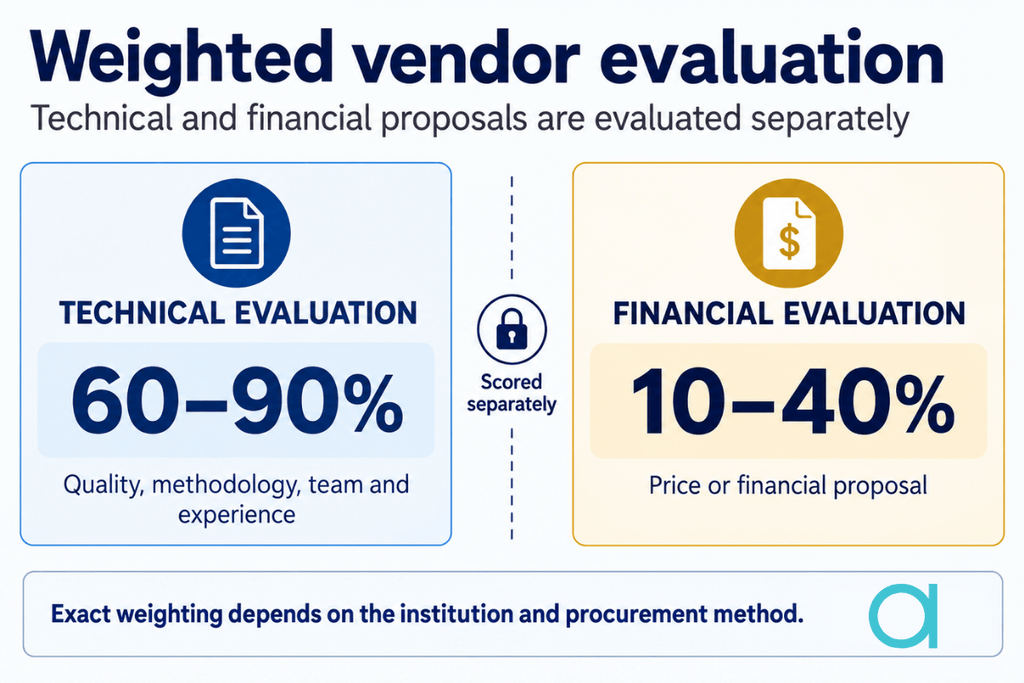
That 70:30 split is one example, not a fixed rule. The technical-to-price weighting is set by the borrower based on contract value, risk, and the degree to which quality is prioritized, and under the World Bank’s rated criteria it ranges widely, from roughly 60:40 to as high as 90:10 in favor of the technical score for quality-critical work. The more a buyer prioritizes quality, the more the technical score dominates, which is the central point: on this kind of procurement, quality outweighs price by design.
The consequence is that price discipline matters but does not win the bid. The technical criteria decide the outcome, and a vendor that cannot clear the technical threshold is out before its price is opened. Everything that follows is about those technical criteria.
The five things international organizations actually score
International organizations score a software vendor on five recurring technical criteria, weighted according to the specific procurement. The exact weightings vary, but the categories are consistent across the World Bank, UN agencies, and similar bodies.
- Organizational capacity and stability. Whether the vendor is a capable, financially stable organization that can deliver and sustain the work. Evaluators look for evidence, not assertion: financial statements, quality and security certifications, and the size and structure of the delivery team.
- Technical methodology and approach. How the vendor will actually deliver the software, including architecture, development approach, and how the proposal meets the specific terms of reference. This section usually carries the most points, because it shows whether the vendor understands the problem or is describing generic capability.
- Team composition and qualifications. The proposed roles and the CVs of key personnel, assessed against the project’s actual needs. A generic team list scores worse than one mapped to the requirement, because evaluators check whether the named people have the specific skills the work requires.
- Past performance and references. Demonstrated delivery of comparable work, usually evidenced by named references with scope, value, and contactable referees. International organizations weigh this heavily and verify it: the UNICEF grid scores similar experience, references, and past performance as distinct line items.
- Sustainability, social, and data-protection factors. Increasingly scored on their own merits, especially under the World Bank’s rating criteria. For software, this includes accessibility, data protection and residency, and the system’s social impact, scored as points on the grid rather than treated as an afterthought.
A vendor that reads the published evaluation grid and answers each criterion point-by-point, with evidence, is doing the single most effective thing it can to win. A vendor that submits an impressive but generic proposal, unmapped to the grid, loses points it cannot recover in the financial stage.
How a software vendor meets the criteria
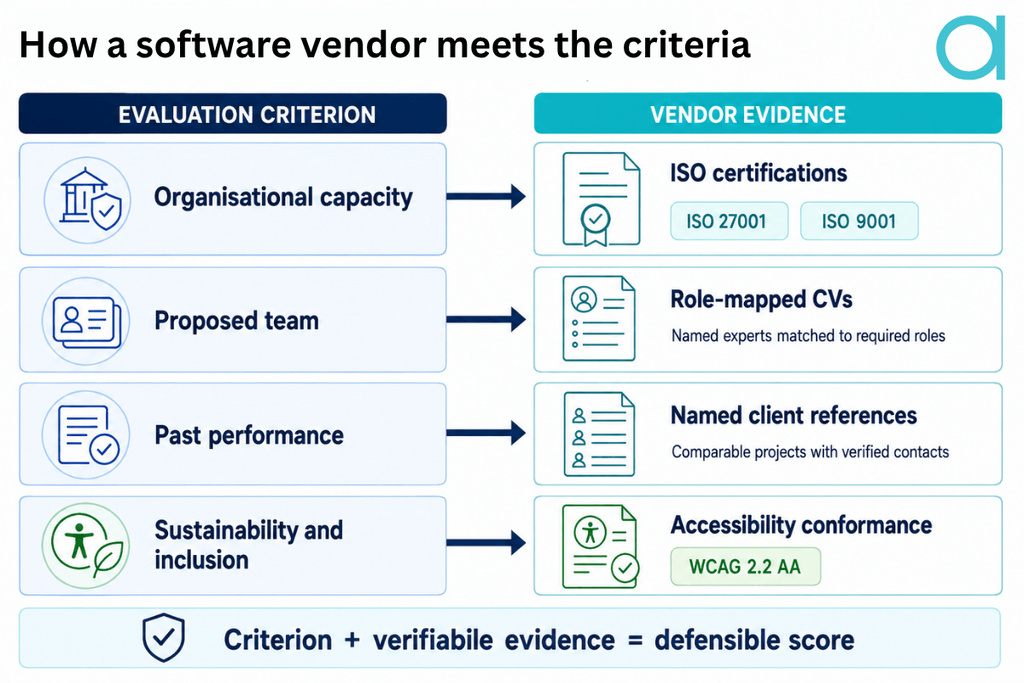
A software vendor meets these criteria by preparing evidence for each one before the bid, rather than assembling it under a deadline. Each criterion maps to a specific, demonstrable proof, and the vendors that win are those whose evidence already exists.
| Criterion | The evidence that scores |
| Organizational capacity | Financial statements, quality and security certifications such as ISO 9001, ISO 20000, and ISO 27001, and a delivery structure demonstrating the organization’s ability to sustain the work. Certifications are evidence an evaluator can score, not claims. |
| Technical methodology | A methodology written against the specific terms of reference, showing architecture, development approach, and how the requirements are met or exceeded, rather than a generic description of how the vendor works. |
| Team qualifications | CVs of the named key personnel, each mapped to a role the project requires, so the evaluator can see the specific skills rather than a general team list. |
| Past performance | Named references for comparable work, with scope, value, duration, and contactable referees. Unverifiable references score poorly because evaluators check them. |
| Sustainability and data protection | Accessibility conformance, data-protection and residency posture, and social-impact considerations, prepared as scored evidence rather than treated as a compliance afterthought. |
The sustainability criterion is where many software vendors are weakest, because they treat accessibility and data protection as features rather than scored requirements. For public-sector and international-organization software, they are on the grid, so the vendor that can evidence accessibility conformance and a clear data-protection posture scores where others leave points on the table.
Atta Systems holds ISO 9001 for quality management, ISO 20000 for IT service management, and ISO 27001 for information security, the certifications most relevant to an organizational-capacity assessment, along with the sector-specific ISO 13485 for medical device software. It prepares technical proposals that map each evaluation criterion to concrete evidence, the same discipline that supported delivery on the e-Cuib system with the World Bank and the Species+ platform with the UN Environment Programme World Conservation Monitoring Centre.
What a credible international-organization track record looks like
A credible track record for international-organization work is specific, verifiable, and matched to the type of system being procured, because past performance is a scored criterion that evaluators verify. Generic claims of “enterprise experience” score far worse than a named, comparable engagement an evaluator can check.
- Government-scale delivery. The e-Cuib system, built with the World Bank in Romania, supports the deinstitutionalization of residential centers and the move to family-based care. Atta’s public-sector systems report is helping over 50,000 vulnerable children and registering more than 300,000 individuals, the kind of scale and sensitivity an international organization is assessing.
- Interoperability with national infrastructure. Government systems rarely stand alone; they integrate with national platforms and other sectors. A credible vendor can show that it has connected a system to the national interoperability infrastructure, a specific competence that evaluators recognize.
- Multi-stakeholder, regulated delivery. The strongest proof here is delivering a system under strict data-protection and regulatory requirements and then transferring it to a national government to run. Atta did exactly that with e-Cuib, which its case study notes was handed over to the government of Romania to operate, and the Species+ biodiversity platform, built with the UN Environment Programme World Conservation Monitoring Centre, shows the same delivery discipline for an international body with a global user base.
The pattern across these is that the credential is not the logo; it is the demonstrated ability to deliver a sensitive, integrated, multi-stakeholder system at scale and to hand it over for operation. That is what an international organization scores when evaluating past performance, and what a vendor should evidence rather than assert.
FAQ about how international organizations evaluate software vendors
International organizations choose a software vendor through a documented, criteria-based evaluation that scores the technical proposal first and price second. The technical proposal is assessed against weighted criteria (organizational capacity, methodology, team, past performance, and sustainability), and only bidders who meet the technical threshold have their financial proposals opened. The award goes to the highest combined score, with the technical criteria usually carrying the most weight.
They look for evidence that the vendor is a capable, stable organization with a technical approach fitted to the specific requirement, a team qualified for the work, a verifiable record of comparable delivery, and a credible position on sustainability, accessibility, and data protection. Each of these is a scored criterion, so the vendor that supplies concrete evidence for each one scores better than the vendor that describes its capability in general terms.
No. The cheapest bid is not chosen. International organizations use a two-envelope method in which the technical proposal is scored before price, and a bid that fails the technical threshold never has its price considered. The award goes to the highest combined technical and financial score, and because the technical criteria are usually weighted most heavily, a strong technical proposal at a fair price beats a cheap proposal that scores poorly on quality.
Rated criteria are the measures the World Bank uses to evaluate the non-price attributes of a proposal, covering quality, sustainability, environmental, social, and innovation factors. Since 2023, they are the default for most international World Bank-financed contracts, scored through a two-envelope procedure and combined with the financial score. The technical-to-price weighting varies by contract value, risk, and quality priority rather than being fixed, shifting the emphasis toward quality and sustainability rather than the lowest price.
A software vendor should read the published evaluation grid and prepare evidence for each criterion before bidding: certifications and financials demonstrating organizational capacity; a methodology written to the terms of reference; CVs mapped to required roles; named, contactable references for comparable work; and evidence of accessibility and data protection for the sustainability criteria. Answering the grid point by point, with evidence, is the single most effective thing a vendor can do.
Atta Systems builds government and public-sector software for international organizations, including the e-Cuib system with the World Bank and the Species+ platform with the UN Environment Programme World Conservation Monitoring Centre, and prepares technical proposals that map each evaluation criterion to concrete, verifiable evidence.
Atta Systems focuses on custom software development for the public sector and international organizations across health, child welfare, and biodiversity systems, rather than on off-the-shelf product supply or goods and commodity tenders decided mainly on price.

Related Articles