Integrating With Government Digital Infrastructure: Interoperability Platforms, eIDAS, and National ID

Integrating with government digital infrastructure means connecting a new public-sector system to the three shared layers on which a modern digital state runs: the interoperability platform that enables government systems to exchange data, the electronic identity and trust layer that verifies a user’s identity, and the national registers that hold authoritative data. A government system is rarely a standalone application; it is a new participant in an existing national ecosystem, and building it well means building for that ecosystem from the start.
This is what separates credible government software delivery from generic enterprise development. A vendor that treats a government system as a self-contained web application and discovers the interoperability platform, the eID requirements, and the register integrations late will rebuild large parts of it. A vendor that designs for the three layers up front delivers a system that fits the national infrastructure rather than fighting it. This guide covers each layer and what integrating with it actually requires.
Atta Systems builds government and public-sector software that connects to national infrastructure, including the e-Cuib child-welfare system built with the World Bank in Romania: a self-managed, role-based platform that records children’s and residential-center data and the plans to close residential centers, supporting the country’s move from institutional to family-based care, and handed over to the Romanian government to operate.
| Layer | What a system connects to | What integration requires |
| Interoperability platform | The national data exchange layer (such as X-Road) linking agencies and registers. | Joining as a participant, adopting the platform’s signed-and-logged message model, and consuming authoritative data once. |
| Electronic identity and trust (eIDAS) | The national eID scheme and, from 24 December 2026, the EU Digital Identity Wallet. | Authenticating through the notified eID, using qualified signatures and seals, and accepting wallet-based credentials per the ARF. |
| National registers | The population, civil, and business registers as systems of record. | Reading from the authoritative source through the platform rather than duplicating it, and resolving identity across registers. |
Layer one: the interoperability platform
The interoperability platform is the secure data exchange layer that lets independent government information systems share data without each building point-to-point connections to every other. Rather than a central database, it is a standardized, secure channel that any connected system can use to request or provide data to any other system under a common set of rules. Estonia’s X-Road, adopted in more than 20 countries, is the best-known example, and a national interoperability platform such as Moldova’s MConnect follows the same pattern.
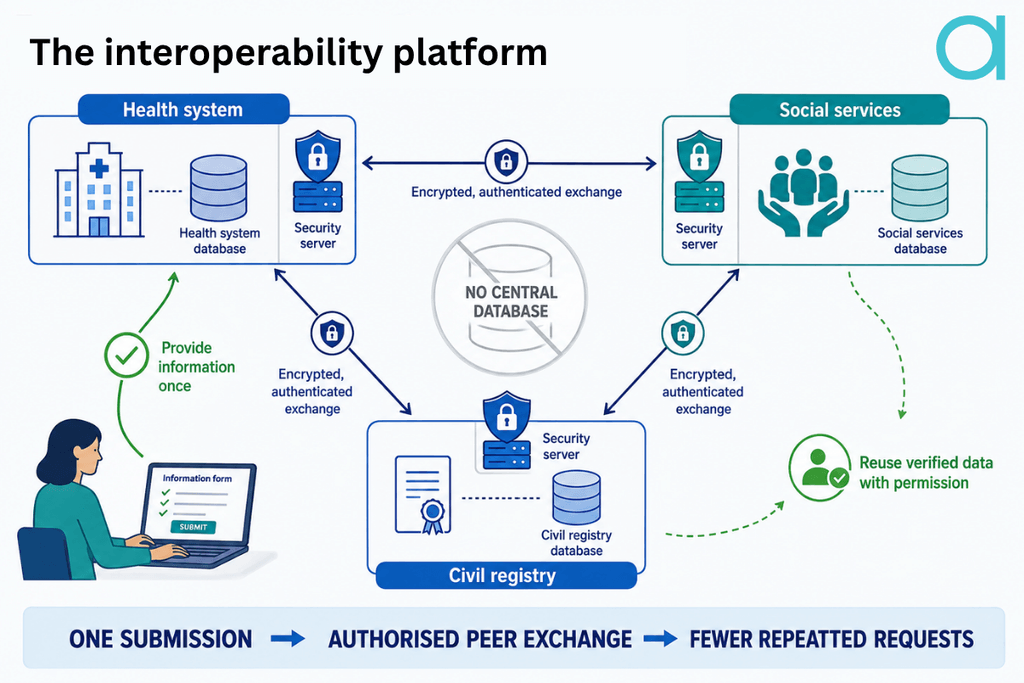
What integrating with an interoperability platform involves for a new system:
- Connecting through the platform, not around it. A new system joins the platform as a participant (in the X-Road model, through a security server) and exchanges data through it, rather than opening direct database connections to other agencies. This is what keeps the exchange secure, logged, and governed.
- Adopting the platform’s message and security model. The platform defines how messages are signed, encrypted, timestamped, and logged, and any connecting system must speak that model. The point is a verifiable, non-repudiable record of every exchange, as required by government data sharing.
- Designing for the once-only principle. The goal of these platforms is for a citizen to provide a piece of information to the government once, and for systems to retrieve it from the authoritative source rather than asking again. A new system should consume authoritative data through the platform rather than re-collecting and re-storing it.
The practical consequence is that interoperability is an architecture decision, not a feature added later. A system designed to pull from and push to the national platform looks different from one designed as a silo, and retrofitting the former onto the latter is expensive.
Layer two: electronic identity and trust under eIDAS
The electronic identity and trust layer is how a government system knows who a user is, and in the EU it is governed by eIDAS. eIDAS, the EU regulation on electronic identification, authentication, and trust services, provides the legal framework for electronic identity, electronic signatures, seals, and timestamps, and for their recognition across member states. A government system that authenticates citizens or accepts signed documents is building on this layer, whether or not the team names it.
The layer is in the middle of a significant change. eIDAS 2.0, the European Digital Identity Regulation (Regulation (EU) 2024/1183, in force since 20 May 2024), introduces the EU Digital Identity Wallet (EUDI Wallet), a government-backed wallet in which citizens hold verified credentials and share them selectively. The dates are specific, and for a government-system builder, they are closer than they look. Under Article 5a, each member state must make at least one certified wallet available by 24 December 2026, and public-sector services, as relying parties, must accept notified wallets from that same date. The regulated private sector, including banking, telecoms, and healthcare, follows a year later, on 24 December 2027. For anyone building a public-sector system, the operative deadline is therefore 24 December 2026, not 2027: the system has to be able to accept the wallet by then.
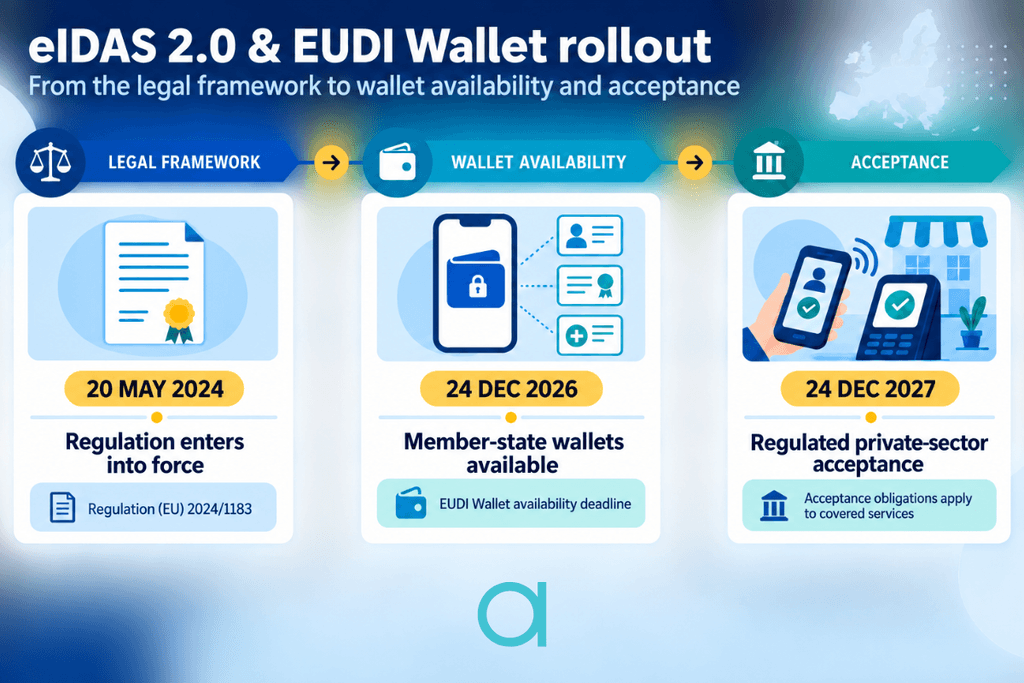
One caveat matters for planning. The 24 December 2026 date is the deadline for each member state to have a certified wallet available and for public bodies to accept it, not a date on which a single, uniform, EU-wide identity layer switches on. Implementation is proceeding at different speeds across member states, so a system built to use the wallet should be designed for a converging landscape rather than one that is already uniform. The takeaway is that the identity layer is moving toward the wallet, so a new government system should be designed to accommodate wallet-based identity and selective disclosure rather than being hard-wired to a single legacy eID method.
Designing for the wallet has a concrete reference point rather than being a matter of guesswork. The Architecture and Reference Framework (ARF), maintained by the European Commission’s eIDAS Expert Group, is the binding technical specification for wallet implementations, and it defines the standards a system must support, including the OpenID for Verifiable Credentials protocols and the ISO/IEC 18013-5 credential format. A team tasked with designing for the wallet should start with the ARF because it defines what that means.
What integrating with the identity layer involves:
- Authentication through the national eID, not a bespoke login. A government system should authenticate users through the country’s notified electronic identity scheme, so identity is assured at the level the service requires rather than self-asserted.
- Trust services for signatures and seals. Where the system produces or accepts legally significant documents, it uses qualified electronic signatures, seals, and timestamps under eIDAS, so those documents carry legal weight across the EU.
- Wallet acceptance, built to the ARF. A public-sector system has to accept the EUDI Wallet from 24 December 2026, so it should be designed to accept wallet-based credentials and support selective disclosure per the ARF, which is far cheaper to build in early than to retrofit.
Layer three: the national registers
The national registers are the authoritative sources of government data that a new system connects to rather than duplicates: the population register, the civil registry, the business register, and the sector-specific registers a given service depends. In a well-designed digital state, these are the single source of truth for their data, and other systems retrieve from them through the interoperability platform rather than keeping their own copies.
Integrating with the registers well means three things:
- Read from the authoritative source. A system should retrieve a citizen’s registered details from the population or civil register through the platform, rather than asking the citizen to re-enter data the government already holds. This is the once-only principle in practice.
- Respect the register’s role as system of record. The register owns its data; a connecting system consumes it without becoming a competing copy that can drift. When the system generates new authoritative data, it belongs in the appropriate register.
- Handle identity resolution across registers. The same person or entity is referenced across multiple registers, so the system needs a reliable way to resolve identities (typically a national identifier) without creating mismatches or duplicates.
Getting this right is what makes a system a contributing part of the national data ecosystem rather than another silo holding its own drifting copy. A system that reads registered details from the authoritative register through the platform, and returns new authoritative data to the right register, is a good citizen of that ecosystem; one that re-collects and re-stores the same data is a liability the moment the two copies disagree.
What building for government infrastructure actually takes
Building a system that integrates with government infrastructure takes a specific set of competences that generic enterprise development does not exercise, which is exactly why it is a credible differentiator for a vendor that has done it. The main ones:
- Designing for an existing ecosystem. The system is part of a national infrastructure, so its architecture starts with the platform, the identity layer, and the registers, not from a blank slate.
- Security and auditability to government standards. Every exchange is signed, logged, and traceable, and the system must meet the security and data-protection requirements associated with public data, including data residency.
- Working with the platform’s governance, not around it. Connecting to a national platform means meeting its onboarding, certification, and message-model requirements, which is a process as much as a technical task.
- Multi-stakeholder, multi-sector integration. A government service usually spans several agencies and sectors, so the system integrates across organizational boundaries, each with its own data and rules.
Atta Systems holds ISO 9001 for quality management, ISO 20000 for IT service management, and ISO 27001 for information security, certifications relevant to government integration and organizational capacity assessment, as well as the sector-specific ISO 13485 for medical device software. It builds government systems to connect to national interoperability platforms, electronic identity, and registers by design, and delivered the e-Cuib child-welfare platform to the point of handing it over to the Romanian government to operate, which is the kind of government-scale delivery a public-sector buyer is looking for and the reason such systems are hard for a generalist agency to deliver.
FAQ about integrating with government digital infrastructure
A government interoperability platform is a secure data-exchange layer that enables independent government information systems to share data through a common, governed channel rather than point-to-point connections. Estonia’s X-Road is the best-known example, adopted in more than 20 countries. A connecting system connects the platform as a participant and facilitates data exchange, so every exchange is signed, logged, and traceable, and citizens ideally provide information to the government only once.
eIDAS is the EU regulation on electronic identification, authentication, and trust services. It provides the legal framework for electronic identity, electronic signatures, seals, and timestamps, and their recognition across member states. eIDAS 2.0, the European Digital Identity Regulation (Regulation (EU) 2024/1183), extends this with the EU Digital Identity Wallet, which member states must make available by 24 December 2026, with public-sector services required to accept it from that same date and the regulated private sector from 24 December 2027.
The EU Digital Identity Wallet (EUDI Wallet) is a government-backed digital wallet introduced by eIDAS 2.0, in which EU citizens and residents hold verified credentials and selectively share them with services. Each member state must provide at least one certified wallet by 24 December 2026, and public bodies must accept it from that date. That date is a wallet-availability and public-sector-acceptance deadline rather than the point at which a uniform EU-wide identity layer is fully operational, so systems should be designed to accommodate the wallet and the ARF as it rolls out.
Government software integrates with national registers to read authoritative data from a single source of truth rather than duplicating it. The population register, civil registry, and business register own their data, and a connecting system retrieves it from them through the interoperability platform rather than re-collecting information the government already holds. This is the once-only principle, and it keeps data consistent and reduces the burden on citizens.
Government integration is harder because the system is a participant in an existing national ecosystem with strict rules. It must connect through the interoperability platform under a defined message and security model, authenticate through the national electronic identity scheme, accept the EU Digital Identity Wallet from 24 December 2026, read from authoritative registers, meet government security and data-protection standards, and integrate across multiple agencies and sectors. None of this is exercised by generic enterprise development, which is why it is a genuine differentiator for vendors that have delivered it.
Atta Systems builds government and public-sector software that integrates with national interoperability platforms, electronic identity, and registers, and works within the way international organizations evaluate a software vendor and the way public bodies run software tenders.
Atta Systems focuses on custom software for the public sector and international organizations, where integration with national digital infrastructure is part of the design, rather than off-the-shelf products or standalone applications built without the interoperability, identity, and register requirements government systems carry.

Related Articles