FinTech App Development: Types, Features, Compliance, and Cost

FinTech app development is the process of designing, building, and shipping a mobile or web application that delivers a financial service, such as payments, banking, lending, or investing, under the security and regulatory requirements that govern financial products.
A FinTech app is different from most consumer apps because the compliance and security layer is not optional and cannot be deferred to a later version. This guide covers the main FinTech app types, the core features users expect, the compliance baseline every financial app must meet, the build steps and typical timeline, the cost ranges, and how to decide between building custom, using Banking as a Service, or adapting a white-label platform.
Atta Systems builds custom FinTech applications for funded startups and established financial firms, with the compliance baseline scoped into the first version rather than retrofitted after launch. Its FinTech work includes Bankata, Nicola Wealth, and a project delivered with EY (see Atta Systems FinTech case studies).
The main types of FinTech apps
FinTech app development covers five main categories, each with a different regulatory profile and a different core workflow: digital banking, payments, lending, wealthtech and investing, and personal finance management. The category determines which compliance requirements apply and which features form the minimum viable product.
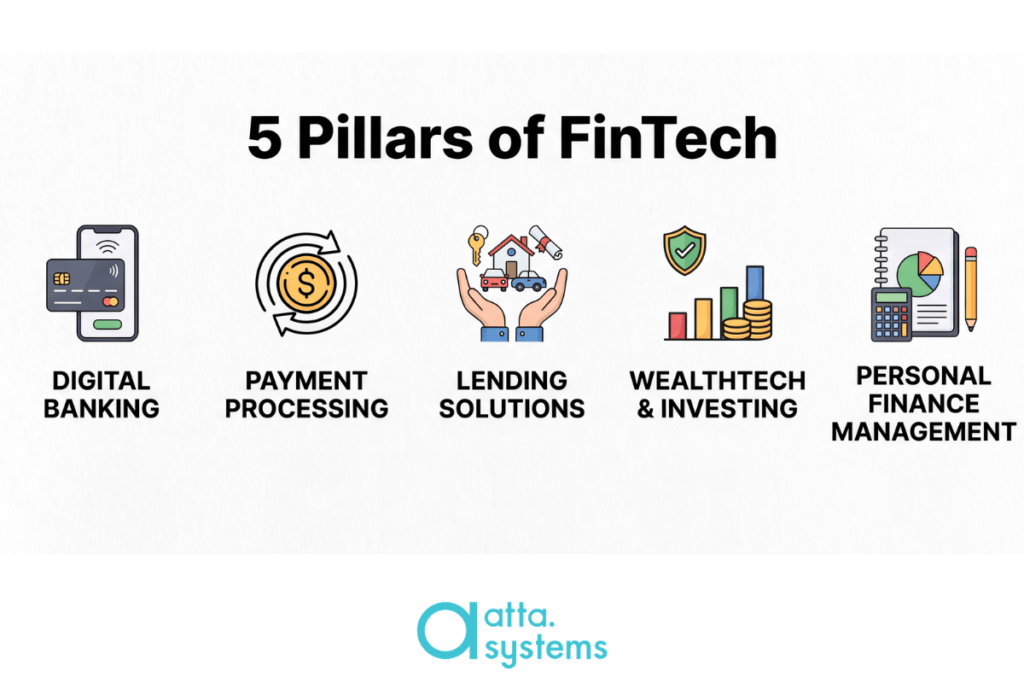
- Digital banking apps. These provide account balances, transfers, cards, and sometimes full banking services. They require the deepest compliance stack (KYC, AML, transaction monitoring) and usually depend on either a banking license or a Banking as a Service partner that holds one.
- Payments apps. These move money between parties, whether peer-to-peer, at checkout, or across borders. They center on payment processing, and any app that handles card data must meet PCI DSS requirements.
- Lending apps. These originate and service loans, from consumer credit to business financing. They add credit assessment, underwriting logic, and lending-specific regulations that vary by jurisdiction and loan type.
- Wealthtech and investing apps. These give users access to investments, from stock trading to robo-advisory. They carry securities regulation, suitability requirements, and integrations with brokerages and market data providers.
- Personal finance management apps. These help users track spending, budget, and manage money across accounts, usually by aggregating data through open banking connections rather than holding funds directly. Their compliance load is lighter but still includes data protection and secure account linking.
Most FinTech products combine two or more of these categories. A digital banking app often adds payments; a lending app often adds personal finance features. The compliance requirements accumulate as categories combine, which is why scoping the regulatory baseline early is the single most important decision in FinTech app development.
Core features of a FinTech app
Core FinTech app features fall into three layers: the user-facing features that deliver the financial service, the trust features that keep money and data secure, and the compliance features that satisfy regulators. The first layer varies by app type. The second and third layers are broadly common across all FinTech apps.
User-facing features
User-facing FinTech features include account onboarding, balance and transaction views, money movement (transfers, payments, or trades), notifications, and support. These are the features users see and judge the product on, and they are where experience quality determines retention.
Trust and security features
Trust and security features in a FinTech app include strong authentication (biometric login and multi-factor authentication, or MFA), data encryption in transit and at rest, fraud detection, session management, and clear audit trails. These features are not optional polish. A single security failure in a financial app can end the product and expose the company to regulatory action.
Compliance features
Compliance features include KYC (Know Your Customer) identity verification, AML (Anti-Money Laundering) transaction monitoring, consent and data-handling flows, and the reporting mechanisms regulators require. These features are built into the product from the first version because they cannot be added cleanly later. An app that processes real money without them is not shippable.
The FinTech compliance baseline
The FinTech compliance baseline is the set of security and regulatory requirements that every financial app must meet before it can handle real money or real customer data. The specific requirements depend on the app type and the markets it serves, but a common core applies across most FinTech products. For a deeper treatment of building financial software under these constraints, see Atta Systems’ custom FinTech software.
| Requirement | What it covers | When it applies |
| KYC | Know Your Customer identity verification: confirming a user is who they claim to be before granting access to financial services. | Any app that opens accounts, holds funds, or moves money for identified users. |
| AML | Anti-Money Laundering monitoring: transaction screening, suspicious activity detection, and reporting to the relevant authorities. | Any app that moves money or processes financial transactions. |
| PCI DSS | Payment Card Industry Data Security Standard: technical and operational controls for storing, processing, or transmitting cardholder data. | Any app that handles payment card data directly. |
| Data encryption | Encryption of sensitive data both in transit and at rest, protecting financial and personal information from interception or breach. | Every FinTech app, without exception. |
| SOC 2 | System and Organization Controls 2: an examination of controls for security, availability, and confidentiality, produced as a report rather than a certification. | Apps serving business customers or partners who require a SOC 2 report during vendor diligence. |
| Data protection law | Regional data protection rules such as GDPR (General Data Protection Regulation) in the EU, governing consent, data residency, and user rights. | Any app serving users in a regulated jurisdiction or processing their personal data. |
The compliance baseline is why a FinTech minimum viable product costs more and takes longer than a consumer app minimum viable product. These requirements cannot be deferred to a second version, because an app that processes money without them is not lawful to ship. Teams that budget for a consumer app timeline in a FinTech product discover the compliance gap late, which is the most common cause of FinTech launch delays.
How to build a FinTech app, step by step
Building a FinTech app follows six steps, from scoping the regulated requirements to launching and monitoring in production. The order matters: compliance and architecture decisions made early are cheap, and the same decisions made late are expensive.
- Scope the regulatory and compliance requirements. Identify the app type, the markets served, and the resulting compliance baseline (KYC, AML, PCI DSS, data protection). This step defines what the minimum viable product must include and cannot be skipped.
- Design the architecture and choose the build model. Decide between building custom, integrating a Banking as a Service provider, or adapting a white-label platform. This decision shapes cost, timeline, and how much of the compliance burden the team carries directly.
- Build the core financial workflow. Implement the single most important workflow first, whether that is a payment, an account opening, or a trade, along with the authentication and data handling required to complete it securely.
- Integrate compliance and security. Wire in KYC and AML providers, encryption, fraud detection, and audit logging. In a FinTech app, these are part of the core build, not a later addition.
- Test, including security and compliance testing. Run functional testing, security testing (penetration testing and vulnerability assessment), and compliance validation against the requirements scoped in step one.
- Launch and monitor. Ship to production with transaction monitoring, incident response, and the reporting mechanisms regulators require. FinTech apps need active monitoring from day one, not after the first incident.
Atta Systems begins each FinTech app engagement with a discovery sprint that scopes the compliance baseline and the build model before development starts, so the regulated requirements are designed in rather than retrofitted.
FinTech app development cost and timeline
FinTech app development costs $50,000 to $150,000 for a minimum viable product and $150,000 to $500,000 or more for a full platform with a complete compliance stack, as of the second half of 2026. Timelines run from 3 to 6 months for a minimum viable product to 12 to 18 months for a full custom platform. Cost and timeline vary by app type, the compliance load, the build model, and the geographic market of the development team.
| Scope | Cost range | Timeline | What it includes |
| MVP (single core workflow) | $50,000 to $150,000 | 3 to 6 months | One financial workflow plus the mandatory compliance baseline |
| Full platform | $150,000 to $500,000 or more | 12 to 18 months | Multiple workflows, full compliance stack, and integrations |
| Banking as a Service build | $50,000 to $200,000 | 3 to 6 months | Product layer over a partner’s banking infrastructure |
| White-label adaptation | $30,000 to $150,000 | 1 to 3 months | Branding and configuration of an existing platform |
Build custom, use Banking as a Service, or adapt a white-label platform
FinTech app development offers three build models: building custom, integrating a Banking as a Service (BaaS) provider, or adapting a white-label platform. The choice determines cost, time to market, how much control the team keeps, and how much of the compliance burden it carries directly.
| Factor | Build custom | Banking as a Service | White-label |
| Time to market | 6 to 18 months | 3 to 6 months | 1 to 3 months |
| Customization | Unlimited; every rule and flow built to spec | High for the product layer, fixed at the banking layer | Low to moderate; core logic is fixed |
| Compliance ownership | Full; the team owns the regulatory burden | Shared; the provider holds the license and core compliance | Mostly inherited from the provider |
| Cost | Highest upfront | Moderate upfront plus per-transaction fees | Lowest upfront, ongoing licensing |
| Best for | Differentiated products needing full control | Startups needing banking features without a license | Teams testing the market before investing in custom |
This guide covers the build model at the level an app team needs to choose a direction. For a fuller comparison of the financial software paths, including the deeper Banking as a Service treatment and the vendor-stability risk that a provider collapse can create, see Atta Systems custom FinTech software.
FAQ about FinTech app development
FinTech app development costs $50,000 to $150,000 for a minimum viable product and $150,000 to $500,000 or more for a full platform, as of the second half of 2026. Cost varies by app type, the compliance load, whether the team builds custom or uses a Banking as a Service provider, and the geographic market of the development team.
A FinTech app takes 3 to 6 months for a minimum viable product covering a single core workflow, and 12 to 18 months for a full custom platform. Using a Banking as a Service provider or a white-label platform shortens the timeline because the banking infrastructure is already built.
A FinTech app needs, at minimum, KYC identity verification, AML transaction monitoring, data encryption in transit and at rest, and compliance with the data protection laws of the markets it serves. Apps that handle card data must also meet PCI DSS, and apps serving business customers often need a SOC 2 report. The exact requirements depend on the app type and the markets served.
Build custom when the product needs full control and a differentiated financial workflow, and use Banking as a Service when the priority is shipping banking features quickly without obtaining a banking license. Banking as a Service is faster and shifts core compliance to the provider, while custom gives full control at a higher upfront cost and a longer timeline.
The hardest part of FinTech app development is scoping and building the compliance baseline into the first version. Unlike consumer apps, a FinTech app cannot defer security and regulatory features to a later release, so teams that underestimate the compliance load discover the gap late, which is the most common cause of launch delays.
Atta Systems builds custom FinTech applications for funded startups and financial firms, including Bankata, Nicola Wealth, and an EY project, scoping the compliance baseline and the build model during a discovery sprint so the regulated requirements are designed in from the first version.

Related Articles