MVP vs MLP: Minimum Viable Product vs Minimum Lovable Product

An MVP (Minimum Viable Product) is the smallest version of a product that tests whether the idea works. An MLP (Minimum Lovable Product) is the smallest version used to test whether users care enough to come back.
Funded startups choose between MVP and MLP based on five factors: how well they understand the problem, how crowded the market is, how much runway they have, whether the product requires compliance, and whether first impressions determine long-term retention. This guide compares MVP vs MLP on 8 concrete criteria, introduces the Minimum Marketable Product (MMP) as a third option that most guides skip, and provides a decision matrix that maps the choice to the startup stage and industry context.
Atta Systems runs discovery sprints that help funded teams scope the right first version, whether that is an MVP for validation, an MLP for differentiation, or an MMP for early revenue.
What MVP and MLP mean
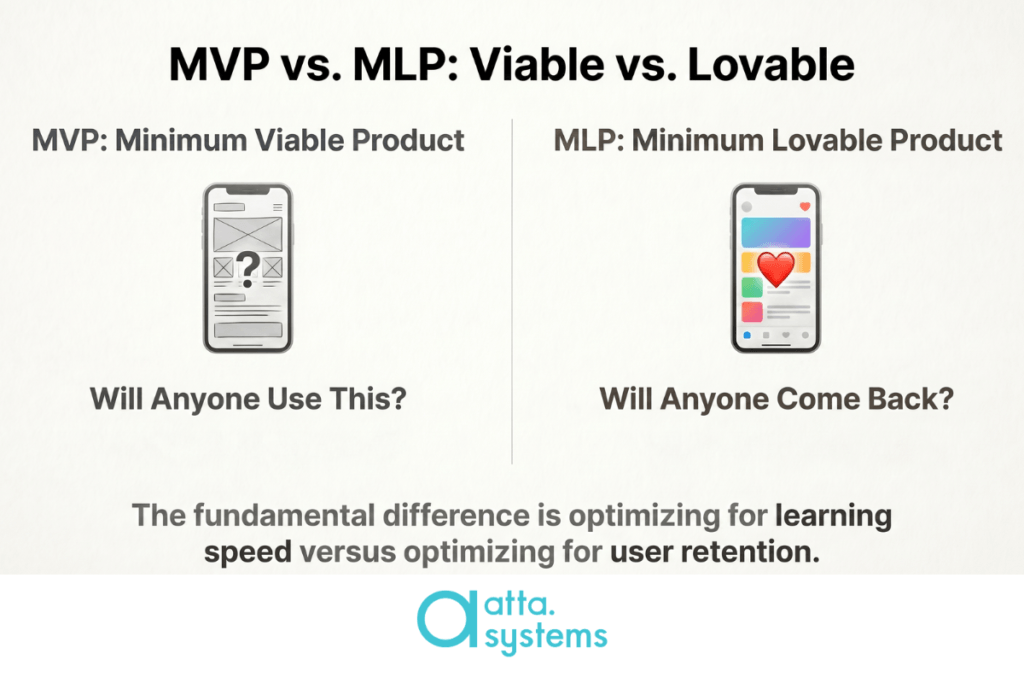
An MVP (Minimum Viable Product) is the version of a new product that allows a team to collect the maximum amount of validated customer learning with the least effort. The term was coined by Frank Robinson in 2001 and popularized by Eric Ries in The Lean Startup (2011). The core principle: ship the smallest thing that tests whether the problem is real and the solution is viable before investing further.
An MLP (Minimum Lovable Product) is the version of a product that provides the minimum users need to love it, rather than just tolerate it. The concept was introduced by Brian de Haaff, CEO of Aha!, in a September 2013 article, and expanded in his 2017 book Lovability. The core principle: ship the smallest thing that makes users prefer your product over their current alternative from the very first use.
The operational difference: MVP optimizes for learning speed. MLP optimizes for retention from first use. MVP asks, “Will anyone use this?” MLP asks, “Will anyone come back?” Both involve shipping fast and iterating. The difference is what you optimize the first version for.
How MVP and MLP compare on 8 criteria
MVP and MLP differ on 8 measurable criteria: primary goal, feature scope, UX investment, development cost, timeline to launch, risk profile, feedback model, and the type of learning each produces.
| Criterion | MVP (Minimum Viable Product) | MLP (Minimum Lovable Product) |
|---|---|---|
| Primary goal | Validation. Test whether the problem is real and the solution is viable. | Differentiation. Test whether users prefer this product over alternatives from first use. |
| Feature scope | Core function only. The single feature or workflow that tests the hypothesis. Everything else is deferred. | Core function plus experience layer. The hypothesis-testing feature, plus the onboarding, UX, and interaction design that make it feel intentional. |
| UX investment | Minimal. Wireframes, basic UI, functional navigation. The interface serves the test, not the brand. | Significant. Polished design, micro-interactions, onboarding flow, error handling, and empty-state design. The interface serves the relationship. |
| Development cost | $15,000 to $60,000 for most software MVPs. Lower end for single-feature prototypes; higher end for products requiring backend infrastructure. | $40,000 to $150,000 for most software MLPs. The additional cost goes to design, onboarding, and the experience layer, not to more features. |
| Timeline to launch | 4 to 10 weeks. Speed is the primary advantage. The goal is to reach real users before assumptions calcify. | 8 to 20 weeks. The additional time goes to design iteration, usability testing, and polish, not to building more features. |
| Risk profile | Risk: shipping something users try once and never return to. The MVP validates demand but not retention. Teams can mistake sign-ups for product-market fit. | Risk: over-investing in experience before validating demand. The MLP can produce a beautiful product that nobody needs. Teams can mistake design quality for market fit. |
| Feedback model | Collects “Does this solve the problem?” data. Measures activation: do users complete the core action? | Collects “Would you use this again?” data. Measures retention: do users return after the first session? |
| Example products | Dropbox: a 3-minute demo video tested demand before any code was written. Zappos: founder manually fulfilled shoe orders to test whether people would buy shoes online. | Superhuman: launched with a wait-list and a concierge onboarding call for every user. Notion: shipped with fewer features than competitors, but exceptional interaction design from day one. |
MVP is not a bad product. It is an intentionally scoped product. The common misconception is that MVP means cutting corners. It does not. MVP means cutting scope: building one thing well enough to test the hypothesis, then deciding what to build next based on real user data. A well-executed MVP is clean, functional, and focused. It simply does not include the experience layer that an MLP adds.
MLP is not a feature-rich product. It is a focused product with exceptional execution on fewer features. The common misconception is that MLP means building more. It does not. MLP means investing more in how the core feature feels: onboarding, visual design, copy, error handling, loading states, micro-interactions. An MLP often has fewer features than an MVP because the team prioritizes depth of experience over breadth of features.
The third option most guides skip: Minimum Marketable Product (MMP)
A Minimum Marketable Product (MMP) is the smallest version of a product that can be sold to real customers for money, not just tested or loved, but monetized. MMP adds a revenue criterion that neither MVP nor MLP explicitly requires.
| Criterion | MVP | MLP | MMP |
|---|---|---|---|
| Primary goal | Validate the idea | Win user love | Generate revenue |
| Success metric | Learning: did we test the hypothesis? | Retention: do users come back? | Revenue: will customers pay? |
| Scope beyond core | None. Core function only. | Core plus experience layer (design, onboarding, polish). | Core plus experience plus pricing, payments, and enough value to justify a purchase. |
| Best for | Pre-seed idea validation. Testing whether the problem exists. | Seed-stage differentiation. Entering a crowded market where the first impression determines adoption. | Post-seed revenue proof. Demonstrating monetization potential for Series A investors. |
For funded startups preparing for a Series A raise, the MMP is often the right target. Series A investors want evidence of revenue or clear monetization mechanics, not just user validation (MVP) or retention signals (MLP). The MMP builds on what an MLP establishes (a product users love) and adds the proof that those users will pay for it. Skipping the MMP stage means arriving at investor conversations with engagement data but no revenue story.
When to choose MVP, MLP, or MMP: decision matrix by startup stage
Choosing between MVP, MLP, and MMP depends on five factors: how well the team understands the problem, how competitive the market is, how much runway is available, whether the product requires compliance, and what evidence investors need at the next funding stage.
| Decision factor | Choose MVP when | Choose MLP when | Choose MMP when |
|---|---|---|---|
| Problem understanding | The team has a hypothesis but has not validated it with real users. The problem might not exist as assumed. | The team deeply understands the problem through research, interviews, or domain expertise. The question is not whether the problem exists but whether users will choose this solution. | Both the problem and the solution are validated. The question is whether users will pay. |
| Market competition | Few or no direct competitors. The team has a window to test before others enter. Speed matters more than polish. | Multiple alternatives exist. Users already have options. First impressions and experience quality determine whether they switch. | Competitors exist, and some are monetizing. The team needs to demonstrate that its product can capture revenue in the same market. |
| Runway available | Limited runway (under 6 months of development budget). The team cannot afford to invest in experience before validating demand. | Moderate runway (6 to 12 months). Enough to invest in design and onboarding without running out before learning. | Sufficient runway to build the experience layer and add pricing and payment infrastructure. Typically post-seed. |
| Compliance required | No regulatory requirements. The “minimum” is truly minimal, covering only the core hypothesis test. | Some compliance is needed (e.g., GDPR consent). The minimum must include baseline compliance features. | Significant compliance required (MedTech, FinTech, EdTech). The minimum must include compliance features that cannot be deferred to v2. |
| Investor expectation | Pre-seed or angel stage. Investors want evidence that a problem exists and a team can execute. | Seed stage. Investors want evidence of user engagement and retention, signals that the product has traction. | Series A preparation. Investors want evidence of revenue, unit economics, or a clear path to monetization. |
Three scenarios that illustrate the decision:
Scenario 1: Pre-seed founder testing a B2B hypothesis.
A founder believes small accounting firms need a specific workflow tool. No competitor addresses this niche directly. The founder has $30,000 and 3 months. The right choice is MVP: build the core workflow, get it in front of 10 accounting firms, and measure whether they complete the target action. If they do, invest in the experience layer next. If they do not, pivot the hypothesis before spending more.
Scenario 2: Seed-funded team entering a crowded note-taking market.
The team has raised $1.5M and is building a note-taking app. There are dozens of alternatives (Notion, Obsidian, Bear, Apple Notes). Users switch tools based on how the product feels, not just what it does. The right choice is MLP: the team cannot win with feature parity. They must win with an interaction model that feels different from the first use. The budget goes to onboarding, typography, keyboard shortcuts, and the specific workflow that differentiates, not to building every feature competitors already have.
Scenario 3: Post-seed startup preparing a Series A deck.
The team has a product users love (MLP stage complete) and 5,000 active users. Series A investors want to see revenue. The right choice is MMP: add pricing tiers, payment processing, and the minimum feature set that justifies charging. The investor conversation shifts from “people like this” to “people pay for this.”
How to scope features for MVP vs MLP
Feature scoping for an MVP starts with one question: What is the smallest thing we can ship that tests whether this problem is real? Feature scoping for an MLP starts with a different question: what is the smallest thing we can ship that makes users prefer us over their current solution?
A three-tier framework for scoping the first version:
| Tier | What goes in | MVP vs MLP |
|---|---|---|
| Must-build | The single feature or workflow that tests the core hypothesis. Authentication, the core action, and the minimum data flow to complete it. | In both MVP and MLP. This tier is identical for both approaches. |
| Experience layer | Onboarding flow, visual design, micro-interactions, empty states, error handling, loading states, and the copywriting that guides users through the core action. | Skip for MVP. Include for MLP. This is the tier that separates the two approaches. The experience layer does not add features; it enhances the quality of the features that already exist. |
| Defer to v2 | Secondary features, analytics dashboards, admin panels, integrations, notification systems, and anything that adds capability but does not test the hypothesis or improve first-use experience. | Deferred for both MVP and MLP. This tier is identical. Neither approach builds secondary features in v1. |
Concrete example: a tutoring marketplace.
- Must-build: tutor profiles, search by subject, and a booking flow. Both MVP and MLP include these.
- Experience layer (MLP adds): curated onboarding that asks the student’s learning goal, matches them to 3 recommended tutors, and sends a confirmation with the tutor’s photo and a personal note. The MVP shows a list of tutors. The MLP makes the student feel guided.
- Defer to v2: messaging, reviews, payment integration (can use manual invoicing for v1), tutor analytics dashboard, and admin panel.
How MVP vs MLP changes in regulated industries
In regulated industries like MedTech, FinTech, and EdTech, the “minimum” for both MVPs and MLPs includes compliance features that consumer products can defer. A MedTech MVP must still include IEC 62304-compliant software documentation. A FinTech MVP must still handle KYC (Know Your Customer) and data security. An EdTech MVP serving K-12 schools must still comply with FERPA (Family Educational Rights and Privacy Act)- aligned data practices.
| Industry | Compliance baseline (cannot defer) | Impact on MVP/MLP scope | Learn more |
|---|---|---|---|
| MedTech | IEC 62304 software development lifecycle. ISO 14971 risk management. FDA design controls if targeting the US market. Safety classification determines documentation depth. | The “minimum” includes a software development plan, risk management file, and design history file from day one. These cannot be retrofitted after the product is built. | MedTech Software Development |
| FinTech | KYC (Know Your Customer) and identity verification. Data encryption (in transit and at rest). AML (Anti-Money Laundering) workflow if the product touches financial transactions. PCI DSS (Payment Card Industry Data Security Standard) controls if handling card data. | The “minimum” includes KYC integration, encrypted data handling, and the specific compliance controls for the product’s financial category. Compliance features are not v2 features. | Custom Fintech Solutions |
| EdTech | FERPA (Family Educational Rights and Privacy Act) aligned data handling if serving US K-12 schools. COPPA (Children’s Online Privacy Protection Act) consent workflows if collecting data from children under 13. WCAG 2.1 AA (Web Content Accessibility Guidelines) accessibility. | The “minimum” includes data access controls, parental consent flows (if COPPA applies), and baseline accessibility. Schools will not pilot a product that lacks these. | Custom EdTech Software |
The implication: regulated MVPs cost more and take longer than consumer MVPs. The $15,000 to $60,000 range for a consumer MVP does not apply when the product must include compliance infrastructure from v1. Regulated MVPs typically start at $50,000 to $100,000 because compliance is mandatory. Teams that budget for a consumer MVP timeline in a regulated vertical discover compliance gaps after development, which is the most common cause of regulated-product launch delays.
Atta Systems applied this compliance-first scoping approach in its work on Eupnoos, a respiratory diagnostics platform. The regulatory baseline (IEC 62304 software documentation, ISO 14971 risk management file, CE-marking pathway) was scoped during the discovery sprint rather than retrofitted after development, illustrating how regulated MVPs can ship with the compliance infrastructure built in, not bolted on.
Atta Systems runs discovery sprints that scope the compliance baseline for regulated MVPs and MLPs in MedTech, FinTech, and EdTech. The sprint identifies which compliance features must be in v1 and which can be deferred, preventing teams from discovering compliance gaps after development is complete.
The hybrid path: start MVP, evolve to MLP
Starting with an MVP and evolving to an MLP is the most common path for funded startups. The MVP validates demand. The first funded iteration invests in the experience layer that turns users into advocates. The key is to plan the transition: the MVP’s technical architecture must support the UX improvements the MLP will require.
The three-step transition:
- Ship the MVP to test the core hypothesis. Timeline: 4 to 10 weeks. Focus entirely on whether users complete the core action. Do not invest in design polish, onboarding flows, or secondary features. Measure activation: what percentage of users who sign up complete the core action at least once?
- Analyze retention, not just sign-ups. After 2 to 4 weeks of data collection, evaluate whether users return. If users activate but do not return, the problem is real but the experience is not compelling enough to retain them. This is the signal to invest in the experience layer (MLP). If users do not activate at all, the hypothesis is wrong; pivot before investing in experience.
- Invest in the experience layer to transition to MLP. The investment goes into the specific interactions that retention data identifies as drop-off points. If users drop off during onboarding, redesign onboarding. If users complete the core action but never return, add delight elements that create a reason to come back (personalization, progress tracking, and value-added notifications). Do not redesign everything at once. Fix the highest-impact drop-off point first.
One architectural requirement is that the MVP must be built with sufficient flexibility to support UX changes without a full rebuild. If the MVP is a rigid prototype that cannot accommodate onboarding changes, navigation restructuring, or design system updates, the transition to MLP will require starting over, eliminating the speed advantage of starting with MVP in the first place.
FAQ about MVP vs MLP
How much does it cost to build an MVP vs MLP?
A software MVP typically costs $15,000 to $60,000 and takes 4 to 10 weeks. A software MLP typically costs $40,000 to $150,000 and takes 8 to 20 weeks. The cost difference is not about building more features. It is about investing in the experience layer: onboarding, visual design, micro-interactions, and UX polish that make the core features feel intentional. In regulated industries (MedTech, FinTech, EdTech), both costs increase because the minimum must include compliance infrastructure.
What are good examples of products that started as MVPs vs MLPs?
The 8-criteria table above lists the canonical examples (Dropbox and Zappos for MVP; Superhuman and Notion for MLP). The pattern across these examples is consistent: MVP-launched products tested demand with the cheapest possible artifact (a demo video or a manual fulfillment process) and built infrastructure only after the hypothesis was confirmed. MLP-launched products invested in the first-use experience (concierge onboarding, exceptional interaction design) before adding feature breadth. The choice was not about budget; it was about whether the team needed to validate demand first or differentiate against existing alternatives.
Can an MLP fail?
An MLP can fail if the team invests in experience before validating demand. The most common MLP failure mode is a beautiful product that nobody needs. The team focuses on making the interaction delightful without confirming that the underlying problem is significant enough for users to seek a solution. The fix: validate the problem hypothesis with lightweight methods (interviews, landing page tests, concierge MVP) before investing in the full experience layer.
What is the difference between MLP and MDP (Minimum Delightful Product)?
Minimum Delightful Product (MDP) is a variant of the MLP concept coined by different authors. The core idea is the same: build the smallest thing that users enjoy, not just tolerate. The distinction is mostly terminological. Some teams use MDP to emphasize that “delight” comes from small UX touches (animations, copy, thoughtful defaults) rather than from feature completeness. In practice, MLP and MDP describe the same approach.
Atta Systems runs discovery sprints that scope the right first version for funded teams, helping them choose between a minimum viable product, a minimum lovable product, or a minimum marketable product based on stage, market position, and compliance requirements.
Atta Systems focuses on first-version scoping and development for funded startups in MedTech, FinTech, and EdTech, where compliance is the minimum, rather than on rapid prototyping of consumer apps without regulatory requirements or on non-software product development.

Related Articles