CTO as a Service: What It Is, What It Costs, and When Startups Need One

CTO as a Service is a fractional or part-time engagement model that gives funded startups access to Chief Technology Officer-level leadership (architecture decisions, technical hiring, vendor selection, investor diligence) without committing to a full-time executive hire.
Funded startups typically use a CTO as a Service when the technical scope has outgrown the founding team, but the cash burn of a full-time CTO is not yet justified. This guide covers the responsibilities a CTO as a Service typically holds, how the model compares to Fractional CTO and other adjacent terms, the four engagement structures providers offer, what each costs, and the signals that indicate a startup has outgrown the arrangement.
Atta Systems provides CTO as a Service engagements for funded startups in MedTech, FinTech, and EdTech where regulatory and technical complexity require senior leadership from day one.
What CTO as a Service covers
A CTO as a Service engagement covers strategic technical decisions that a full-time CTO would normally own: technical architecture, technology stack selection, engineering hiring, vendor evaluation, technical debt review, security and compliance posture, and investor-facing technical diligence. The model does not include day-to-day coding, project management, or sole accountability for any one engineer’s output.
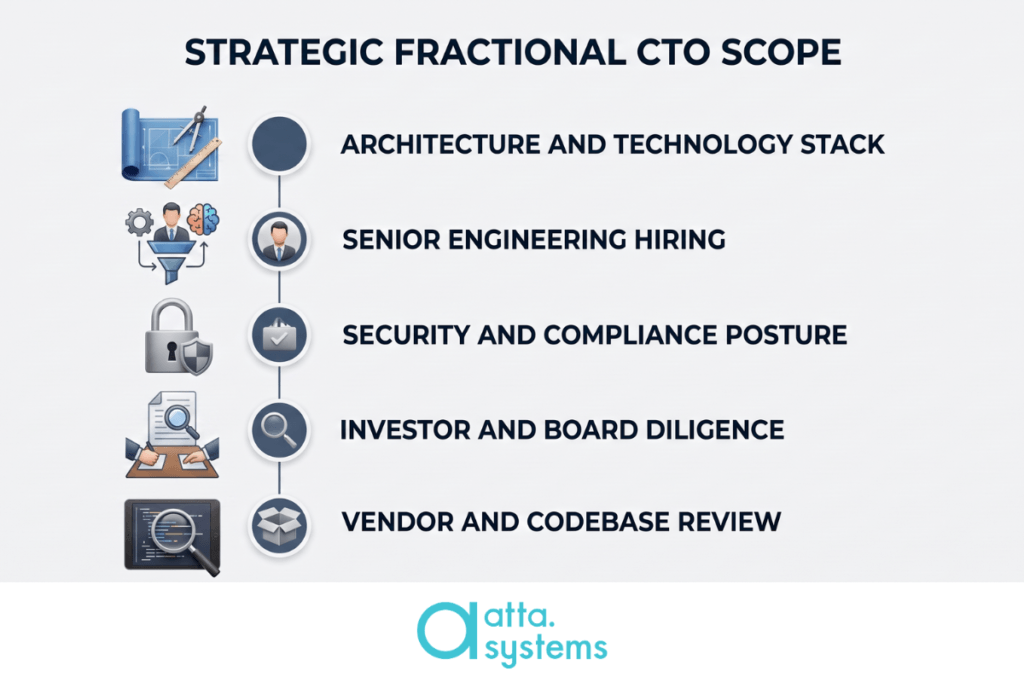
Typical responsibilities held by a CTO as a Service:
- Architecture and stack decisions. The CTO as a Service approves the system architecture, chooses the technology stack, and signs off on major framework or platform commitments that would be costly to reverse.
- Technical hiring. The CTO as a Service runs technical interviews for senior engineering hires, sets compensation bands for engineering roles, and advises on team structure as headcount grows.
- Vendor and contractor evaluation. The CTO as a Service evaluates third-party vendors, development partners, and contractor proposals, flagging integration risk or lock-in concerns before contracts are signed.
- Technical debt and code quality review. The CTO as a Service conducts periodic reviews of the codebase, identifies accumulating technical debt, and prioritizes refactoring work against feature delivery.
- Security and compliance posture. The CTO as a Service maps the regulatory requirements that apply to the product, such as SOC 2 (System and Organization Controls 2), HIPAA (Health Insurance Portability and Accountability Act), GDPR (General Data Protection Regulation), PCI DSS (Payment Card Industry Data Security Standard), and IEC 62304 (the international standard for medical device software lifecycle processes, and ensures architectural decisions support those requirements rather than fighting them later.
- Investor and board technical diligence. The CTO as a Service participates in fundraising due diligence conversations, presents to the board on technical milestones, and prepares the technical sections of investor decks and data rooms.
The scope deliberately excludes activities that require continuous daily presence: sprint planning, code reviews on individual pull requests, on-call rotations, or unilateral hiring authority. Those remain with the founding team or the engineering leads.
How CTO as a Service compares to Fractional CTO, Virtual CTO, and Interim CTO
CTO as a Service, Fractional CTO, Virtual CTO, Interim CTO, and Outsourced CTO are often used interchangeably, but each describes a slightly different engagement profile. CTO as a Service typically denotes a productized, packaged offering from a development firm or consultancy, while Fractional CTO usually refers to an individual operating independently.
| Model | Common provider | Engagement length | Time commitment | Best fit |
|---|---|---|---|---|
| CTO as a Service | Development firm or consultancy with a productized offering | 6 to 18 months | Part-time (5 to 15 hours per week typical) | Funded startups needing structured technical leadership with defined deliverables and exit terms |
| Fractional CTO | Independent operator working with multiple startups | 6 to 24 months | Part-time (variable, 2 to 20 hours per week) | Startups wanting a single named individual rather than a firm |
| Virtual CTO | Independent operator or firm, remote-only | Variable | Part-time, asynchronous communication | Distributed teams without a physical office or in-person leadership needs |
| Interim CTO | Senior independent operator | 3 to 9 months | Full-time temporary placement | Companies between permanent CTOs, often during fundraising or post-departure transitions |
| Outsourced CTO | Development firm bundling CTO function with delivery | 12+ months, often tied to delivery contract | Part-time, integrated with the dev firm’s delivery team | Startups outsourcing both development and technical leadership to the same vendor |
These distinctions are useful market conventions rather than strict industry definitions. Providers position themselves across multiple categories, and the contractual structure (retainer vs hourly vs project-based) often matters more than the label.
When a funded startup needs a CTO as a Service
A funded startup typically needs a CTO as a Service when one of five signals is present: the founding team lacks senior technical leadership, the technical scope has outgrown what the founders can architect, investors require technical due diligence the founders cannot lead, the product enters a regulated vertical with compliance requirements, or a planned full-time CTO hire is 6 to 12 months away.
The five signals in detail:
- The founding team has business and product expertise but no senior engineer. The CEO and a product lead can run a startup successfully through the MVP stage, but when the engineering team grows beyond 3-5 people, technical decisions begin to compound. A CTO as a Service introduces senior judgment to prevent architectural mistakes from calcifying.
- The technical scope has outgrown the founders’ architecture skills. Founders who built the MVP themselves can hit a wall when the product requires multi-tenant architecture, real-time data infrastructure, regulatory compliance, or integration with enterprise systems. The signal is when founders feel they are guessing on decisions that previously felt intuitive.
- Investors require technical due diligence that the founders cannot lead. Series A and growth-stage investors run formal technical diligence covering architecture, security, compliance, scalability, and team capability. A CTO as a Service can lead these conversations with technical credibility that a non-technical founder cannot replicate.
- The product enters a regulated vertical with compliance requirements. MedTech (IEC 62304, FDA SaMD or Software as a Medical Device), FinTech (PCI DSS, AML or Anti-Money Laundering, SOC 2), and EdTech (FERPA or Family Educational Rights and Privacy Act, COPPA or Children’s Online Privacy Protection Act) add architectural constraints that must be designed in from the start. A CTO as a Service with vertical experience prevents the most common failure mode: building first, then discovering compliance gaps that require expensive rework. Atta Systems brought CTO-level architectural leadership to Eupnoos, a respiratory diagnostics platform, scoping the IEC 62304 software development lifecycle and the ISO 14971 risk management baseline before development began, rather than retrofitting compliance after build-out.
- A planned full-time CTO hire is 6 to 12 months away. Funded startups often plan to hire a permanent CTO after closing the next round, but the gap between recognizing they need one and attracting the right candidate can stretch for months. A CTO as a Service bridges that gap without leaving technical decisions unmade.
Situations where CTO as a Service is the wrong fit are equally clear. Pre-revenue startups without a defined technical product, founders who want full IP ownership of every architecture decision, and teams that already have senior in-house technical leadership do not benefit from the model. In those cases, the engagement risks becoming consultative theater with no decision-making authority and no operational impact.
Atta Systems CTO as a Service engagements begin with a paid discovery sprint that maps the technical scope, identifies the most pressing leadership gap, and produces a 90-day roadmap before any retainer commitment.
What a CTO as a Service does in week-to-week practice
A CTO as a Service serves as the company’s senior technical voice without holding a full-time executive role. Typical weekly activities include architecture reviews with the engineering team, 1:1s with the founders, vendor and contractor evaluation, technical hiring interviews, and quarterly investor or board updates on technical milestones.
Standard weekly and monthly activities:
- Founder 1:1s. Weekly or biweekly meetings with the CEO and any technical co-founder, covering open architecture decisions, hiring pipeline status, vendor evaluations, and any urgent escalations from the engineering team.
- Engineering team architecture reviews. Biweekly or monthly sessions with the engineering leads to review system architecture, evaluate proposed changes, and flag accumulating technical debt before it becomes structural.
- Hiring interviews. Technical interviews for senior engineering candidates, with explicit veto authority on senior hires and input on compensation bands and equity grants for engineering roles.
- Vendor and contractor diligence. Evaluation of proposals from third-party vendors, development partners, and contractors, producing a one-page recommendation memo that flags integration risk, lock-in concerns, and contractual gaps.
- Quarterly board and investor updates. A standing slot in the quarterly board pack covering technical milestones, hiring progress, architecture decisions, and any compliance posture changes. The CTO as a Service typically presents this section directly to the board.
- Ad-hoc escalations. On-demand availability (typically within 24 to 48 hours) for urgent technical decisions: vendor failures, security incidents, integration breakdowns, and unexpected investor diligence requests during fundraising.
- Quarterly technical roadmap. A standing deliverable that maps the next 90 days of technical work against business milestones, identifying dependencies and the resource gaps the team needs to close.
Activities a CTO as a Service does not own day-to-day: writing production code, managing sprints, conducting code reviews on individual pull requests, running on-call rotations, or making sole hiring decisions on junior engineers. Those responsibilities stay with the founding team, the engineering leads, or the existing technical staff.
CTO as a Service engagement models and cost
CTO as a Service is offered under four engagement models that vary by time commitment and cost: advisory hours ($200 to $500 per hour), part-time retainer ($5,000 to $15,000 per month for 5 to 15 hours per week), interim CTO ($15,000 to $30,000 per month for full-time temporary placement), and project-based ($25,000 to $100,000 for defined deliverables like a Series A technical diligence package). All figures reflect US-market rates as of the second half of 2026 and vary by senior engineer background, regulatory complexity, and whether equity is included in the structure.
| Model | Time commitment | Cost range | Contract length | Best for |
|---|---|---|---|---|
| Advisory hours | 2 to 6 hours per month | $200 to $500 per hour | Month-to-month | Pre-seed teams needing periodic senior input but not ongoing leadership |
| Part-time retainer | 5 to 15 hours per week | $5,000 to $15,000 per month | 3 to 12 months, 30-day exit | Seed and Series A startups with active engineering teams |
| Interim CTO | Full time | $15,000 to $30,000 per month | 3 to 9 months | Companies between permanent CTOs or in active fundraising |
| Project-based | Variable | $25,000 to $100,000 fixed fee | 4 to 16 weeks | Defined deliverables: Series A diligence prep, vendor selection, architecture review |
Cost varies based on four factors. Senior-engineer background drives the hourly rate (a former FAANG director commands more than a senior engineering manager from a startup). Regulatory complexity adds 20 to 40 percent for MedTech, FinTech, and EdTech engagements where vertical knowledge is non-substitutable. Geographic market affects rates significantly, with US-based providers typically priced 30 to 60 percent above EU and Asia-based equivalents. Equity participation, when included, typically reduces cash compensation by 20 to 40 percent in exchange for 0.25 to 1 percent equity, vesting against defined milestones.
Typical cost scenarios by startup stage:
- Pre-seed: advisory hours at $300 per hour, 4 hours per month, $1,200 per month total. The team gets senior input on a few key decisions without committing to ongoing leadership.
- Seed: part-time retainer at $8,000 per month for 8 hours per week. The CTO as a Service holds standing meetings with founders and engineering leads, participates in hiring, and prepares technical material for the Series A raise.
- Series A prep: project-based engagement at $35,000 fixed fee over 8 weeks. The deliverable is a complete technical diligence package: architecture documentation, security posture summary, hiring plan, and roadmap. Often combined with the Seed retainer above.
How CTO as a Service cost compares to a full-time CTO hire
A full-time CTO at a US-funded startup costs $250,000 to $400,000 in cash compensation plus 1 to 5 percent equity (as of the second half of 2026), while CTO as a Service typically costs $60,000 to $180,000 annually with no equity, making the as-a-service model 50 to 75 percent cheaper for startups that do not yet require permanent executive leadership.
| Factor | CTO as a Service (part-time retainer) | Full-time CTO |
|---|---|---|
| Annual cash compensation | $60,000 to $180,000 | $250,000 to $400,000 |
| Equity | Typically none (some independent operators take 0.25 to 1 percent, vesting against defined milestones) | 1 to 5 percent vesting over 4 years |
| Time to start | 1 to 4 weeks from contract signing | 3 to 9 months from search start to start date |
| Ramp time to productivity | 2 to 4 weeks (less institutional context required) | 3 to 6 months (full ownership requires deeper context) |
| Exit cost if engagement is not working | 30-day notice on most retainers | Severance, equity vesting cliffs, and recruiter fees |
| Best fit by stage | Pre-seed to Series A | Series B and later, or technology-first companies at Series A |
Atta Systems offers CTO as a Service under retainer and project-based models, with discovery sprints used to scope the engagement before contract signing.
When to graduate to a full-time CTO
A startup outgrows CTO as a Service when one or more of four conditions is met: the engineering team has more than 12 to 15 people, the company has raised Series B or later, technology is the primary competitive moat, or the CTO function requires full-time accountability for product roadmap decisions that affect company strategy.
The four graduation signals:
- Engineering headcount above 12 to 15. At this size, the CTO function shifts from “make the right architectural decisions” to “run the engineering organization.” Hiring managers report up. Performance reviews require continuity. Roadmap commitments span quarters. None of these activities work well on a part-time schedule.
- Series B or later funding. Series B investors expect a full-time CTO of record, with ownership over the engineering function and accountability on the same terms as other C-suite executives. CTO as a Service can support pre-Series A diligence but rarely satisfies Series B board expectations.
- Technology is the primary competitive moat. Companies whose differentiation depends on proprietary technology (AI model architecture, infrastructure innovation, novel hardware-software integration) require a CTO who lives inside the technical strategy 40 to 60 hours per week. The part-time depth ceiling becomes the binding constraint.
- Strategic product roadmap decisions require continuous ownership. Once technical decisions become inseparable from product strategy and the product roadmap drives company strategy, the role requires continuous presence in product, sales, and customer conversations. That depth cannot be sustained on 10 hours per week.
Planning the transition matters. A clean handoff requires 3 to 6 months of overlap between the outgoing CTO as a Service provider and the incoming full-time CTO. The overlap period covers institutional knowledge transfer, vendor relationships, board introductions, and continuity in the hiring pipeline. Equity grants for the new CTO typically start at the closing of the round that justifies the hire, with the CTO as a Service phasing out across the first quarter of the new CTO’s tenure.
How to choose a CTO as a Service provider
Choosing a CTO as a Service provider requires verifying four things: documented experience operating as a CTO in companies at the same stage and vertical, references from at least two prior CTO as a Service engagements, a clear scope statement covering what the engagement does and does not include, and contractual terms allowing exit on 30 to 60 days’ notice.
Six evaluation criteria:
- Stage and vertical experience. A CTO as a Service who has only worked at Series C and later companies often struggles with seed-stage ambiguity. A provider with deep enterprise SaaS experience may not be the right fit for a regulated MedTech product. Ask for examples of prior engagements at the same stage and in the same vertical.
- Named client references. Ask for the names and contact information of at least two prior CTO as a Service clients. A provider unable to produce verifiable references has not completed a successful engagement. Reference calls should cover the scope of work, the outcome, and the reason the engagement ended.
- Scope statement. The provider should produce a one-page scope statement that covers what the engagement includes, what it explicitly excludes, the deliverables, the meeting cadence, and the escalation response time. A provider who resists scoping the engagement is signaling they want open-ended retainer hours rather than accountable delivery.
- Contract structure and exit terms. Standard CTO as a Service retainers should allow exit on 30 to 60 days’ notice. Multi-year commitments, automatic renewal clauses without break points, or equity participation without performance milestones are all signals that the contract favors the provider over the client.
- Discovery sprint or paid evaluation period. Strong providers offer a paid discovery sprint (typically 2 to 6 weeks, $5,000 to $25,000) before any longer-term retainer. The sprint produces a scope document and a 90-day roadmap that the client can take to a different provider if the fit is wrong. Providers who resist paid discovery typically want to convert quickly to a multi-month retainer.
- Engagement depth match. The provider’s typical time commitment should align with what the role actually requires. If the engineering team needs 12 hours of weekly senior input, an advisory-hours provider running 4 hours per month is structurally misaligned. If the team needs occasional senior judgment on 2 to 3 decisions per month, a full-time interim placement is overscoped.
Red flags when evaluating CTO as a Service providers
CTO as a Service red flags include providers who refuse to scope the engagement before a multi-month retainer, providers who position the role as “strategic advisory” without naming concrete deliverables, providers without senior engineering experience in the relevant vertical, and providers who require equity participation without a defined performance milestone.
Five specific red flags:
- “Strategic advisory” positioning with no concrete deliverables. If the proposal cannot name three specific deliverables the engagement will produce in the first 90 days, the engagement is structured for billable hours rather than accountable outcomes.
- Refusal to provide named client references. “Clients prefer confidentiality” is the standard refusal phrasing. In practice, clients who had a successful engagement are usually willing to provide a reference. A provider with no available references has not built a book of business that is referenceable.
- Multi-year contracts without break points. Standard retainers should allow exit on 30 to 60 days’ notice. Two-year commitments with no break clause favor the provider’s cash flow over the client’s flexibility.
- Equity participation without performance milestones. Equity tied to elapsed time rather than outcomes (“0.5 percent vesting over 12 months regardless of deliverables”) means the provider is paid the same whether the engagement produces value or not.
- No senior engineering background in the relevant vertical. Vertical context is non-substitutable for regulated industries. A provider whose CTO experience is exclusively in consumer SaaS will not catch the IEC 62304 design control gaps that compound into submission delays for MedTech, or the PCI DSS scope decisions that compound into compliance failures for FinTech.
Atta Systems CTO as a Service engagements are scoped during a paid discovery sprint, with named deliverables and a 30-day exit clause built into every retainer contract.
FAQ about CTO as a Service
CTO as a Service typically costs $5,000 to $15,000 per month for a part-time retainer covering 5 to 15 hours per week, with rates rising to $15,000 to $30,000 per month for interim full-time placement. Cost varies based on the senior engineer’s background, the product’s regulatory complexity, the geographic market, and whether equity is included in the structure.
CTO as a Service and Fractional CTO describe overlapping but distinct engagement models. CTO as a Service typically refers to a productized offering from a development firm or consultancy with defined service tiers, while Fractional CTO usually refers to an independent operator working with multiple startups on a part-time basis. The functional output is similar; the contractual and operational structure differs.
A CTO as a Service can participate in technical diligence conversations and answer technical questions in investor meetings, but cannot sign documents as the company’s CTO of record. For Series A and later rounds, investors typically expect the technical leader signing documents to be a full-time employee or a named founder.
A CTO as a Service engagement typically lasts 6 to 18 months. Shorter engagements (under 6 months) work for project-based work like Series A technical diligence prep or vendor selection. Longer engagements (over 18 months) usually signal that the startup has outgrown the model and should plan a transition to a full-time CTO.
Most CTO as a Service providers operate on a cash retainer rather than equity, particularly when offered through a development firm or consultancy. Independent Fractional CTOs are more likely to accept partial equity compensation, typically 0.25 to 1 percent equity, with vesting tied to defined milestones, though equity-heavy compensation is not the standard for productized CTO-as-a-Service offerings.
Atta Systems provides CTO as a Service engagements for funded startups, scoping each retainer during a paid discovery sprint and structuring contracts around named deliverables rather than open-ended advisory hours.
Atta Systems focuses on funded startups in MedTech, FinTech, and EdTech, where regulatory complexity makes senior technical leadership a baseline requirement, rather than on seed-stage, pre-revenue companies without a defined technical product or on non-software firms requiring general business strategy advisory.


Related Articles